Apps Win Moments. Agents Win Journeys.
Your customers do unpaid work between your apps. Agents are the first thing built to carry the whole journey, stopping only where a person decides. When your customer's agent arrives, will it find a door or a wall?

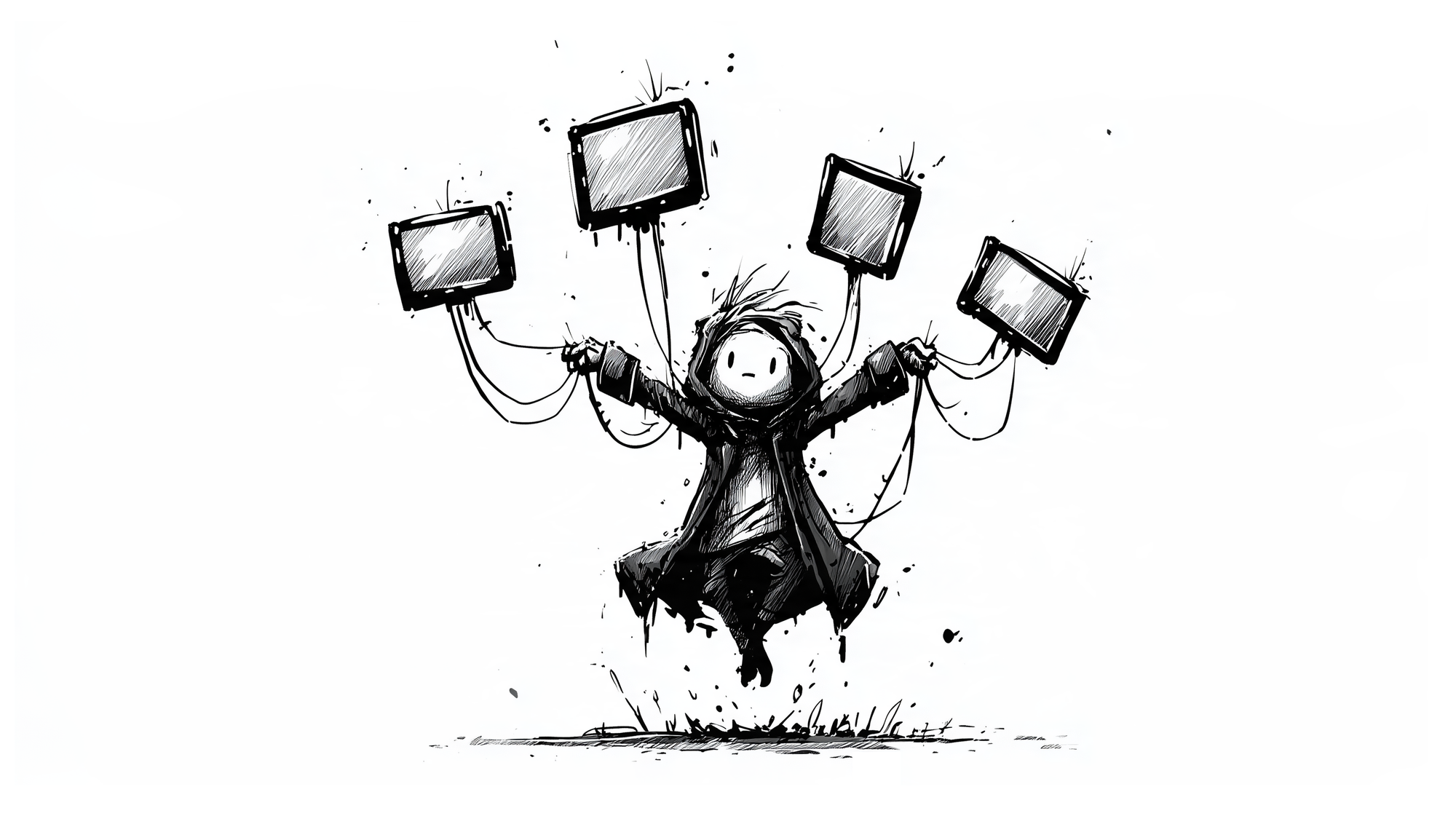
You have an app for what you eat, one for your steps, one for your sleep, and not one of them knows the others exist.
So you do the connecting. You notice the bad night, skip the run, log the pizza, and promise yourself a better week. You think that's a crowded phone. It's a job, and you've been doing it for free. The journey you actually want, a healthier year, has no owner, and this year every major AI platform launched or previewed something that could own it.
I believe the customer journeys you lose next won't go to a better app but to an agent that finishes them, because apps were built for moments and your customers live in journeys.
Your phone is brilliant at moments.
Now switch seats. You also own one of those apps, or the roadmap behind it.
You walk out of a hotel and need a cab. You want to know if it's raining. You pay at a counter with your watch. For moments like these, the phone is close to perfect, and it's done. The next one will be faster, the screen a bit bigger, maybe it folds. It won't change what you do with it. It's great for moments. It's terrible at journeys.
Every wave of service, from the counter to the desktop to the phone, handed more of the work back to you. My grandfather did his banking face to face, with someone who did it with him. Then we filled in forms at home in the evening. Then we did it ourselves, anywhere, in seconds. Each wave made the moment quicker. None of them made the journey shorter.
You carry a supercomputer in your back pocket. It can't finish a single journey.
That's the trap for anyone who owns an app. You measure the moment: taps, sessions, ratings. Your customer lives the journey, and most of it happens outside your app, where nobody measures whether it ever finished.
You are the frantic API.
An API is what connects two systems. Your customers are the frantic, human version. They copy, they paste, they retry, and they switch apps. All day. Nobody designed that job. It's what's left over when every company builds for its own moment.
Take that healthier year. Everyone wants one, and the app stores are full of help: food, sport, sleep, meditation, habits. Not one app takes the whole journey. Honestly, we half like it that way. This company knows what I eat, that one knows how I sleep, and nobody knows everything. Hold on to that thought. It comes back.
There's a second kind of AI you already know. Look at one car online and it follows you around the web for weeks. That AI works on you. An agent works for you: here's the car I want, here's my budget, find it and tell me when it's worth deciding.
You are the glue between apps, and nobody pays you for it.
So your customer is doing unpaid integration work between your app and everyone else's. Whoever takes that work off their hands owns the relationship. If it isn't you, it will be their agent.
An agent carries the whole line.
Draw any customer journey as a line. I call it the Journey Line: intent, find, compare, decide, act, follow through. Your app owns one stretch of it, maybe two. The customer jumps between stretches owned by different companies, carrying the context in their head. An agent is the first thing built to walk the whole line. It stops only where a person has to decide.
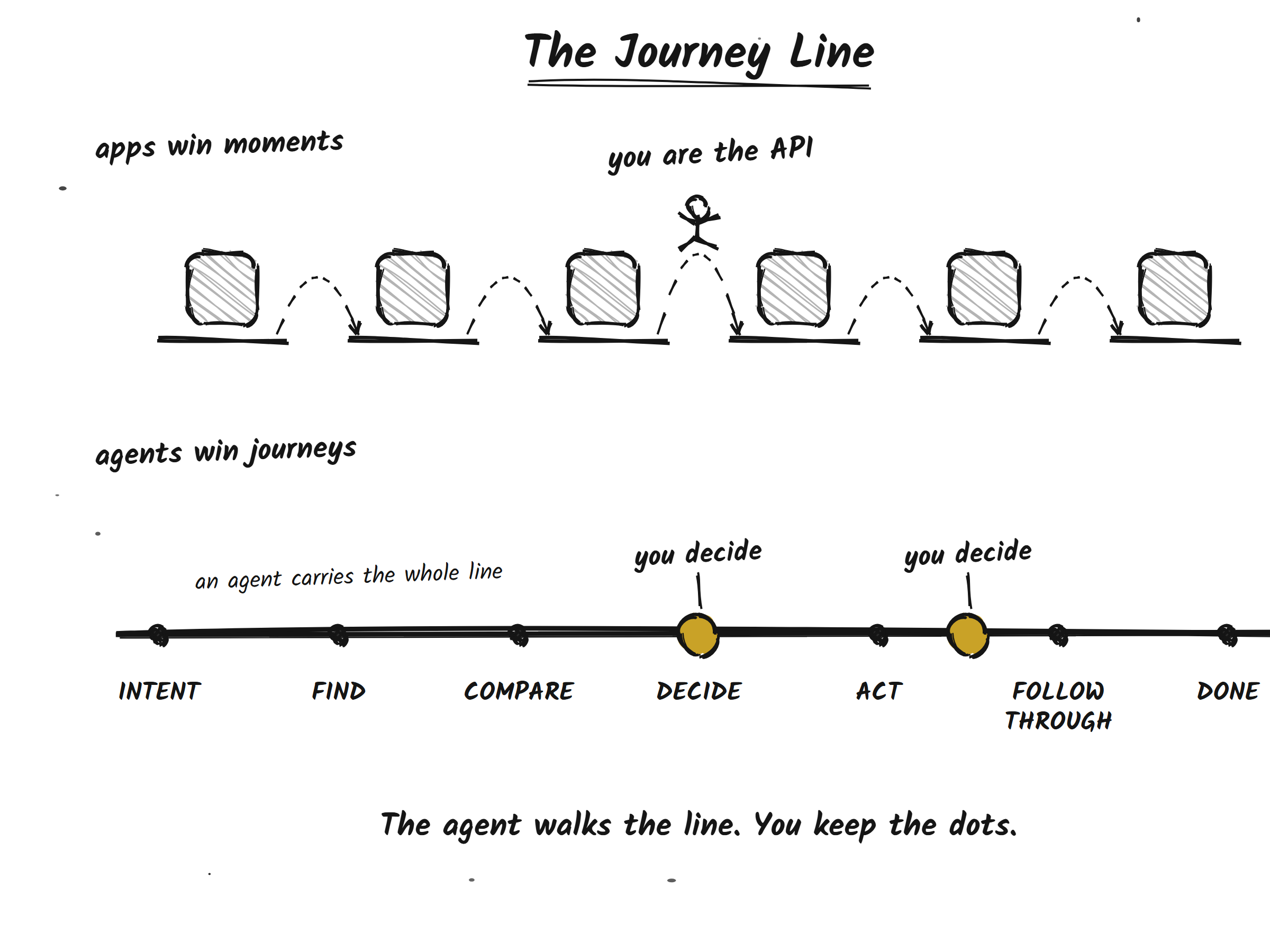
Take moving house, a journey that every bank, insurer, and energy company touches. The intent fits in one sentence: we move on the first of March. Then the line starts. Find a mover and compare quotes. Tell the bank, the insurer, the energy supplier, the employer, and the school. Move the internet. Change the address on a dozen accounts. Chase the old supplier when one more bill arrives.
Every company on that line has a decent app for its own step. None of them carries the move. You do, in the evenings, for weeks.
An agent could carry it. It knows the date, and it can read the contracts, fill in the forms, and chase the stragglers. It needs you twice: to pick the mover, and to approve the new home insurance. That's two gold dots on a line of thirty steps. If yours is one of those companies, which stretch do you own today, and what does your app do when the customer's agent shows up instead of the customer?
This is possible now because of how fast agents are learning to work alone. METR, an independent lab that tests what AI systems can do without help, finds that the length of task an AI can finish on its own has been doubling roughly every four months since 2023 [1].
That's on software and research work, and METR itself says its yardstick is running out of room at the top. Still, a thirty-step move is that kind of long task. Apps were built for single steps of it.
The best journeys won't even need an instruction. My calendar says Brussels at ten and I'm standing on the platform of the train station. You know where I am. You know where I'm going. Do it for me. Your life becomes the command line.
The agent walks the line. You keep the dots.
The dots are where the value sits. The most impressive thing I've seen an agent do was stop and hand control back at the right moment. When my agent found cheap birdhouses on a Sunday hike, it left links waiting, and I still ordered them myself. Agents do the work, people keep the judgment. Design for the points where your customer really decides, and let the line take care of the rest.
The line-up is complete.
Your customers can now hire someone for the job they do between your apps. Between May and October, Google, Meta, OpenAI, Microsoft, Anthropic, and Elon Musk's SpaceXSI all launched or previewed an agent that keeps working after you put the phone down [2][3][4][5].
Amazon had already put Alexa+ in every American home that wanted it in February, and Apple's new Siri started acting across apps in September. Underneath, most of them look alike: a computer in the cloud that keeps going without you, connections into your apps and accounts, and a point where it stops and asks you first.
People are trying them. Meta's Muse passed ten million US downloads in its first 40 days, nearly three times what ChatGPT's app managed in the same window, by Sensor Tower's estimate, with Meta's whole ad machine behind it [6]. Downloads aren't loyalty, and I'll come back to that. But your customers are being taught, at scale, to hand a task to something that isn't an app.
In January I wrote that the Agent-First Era had begun. It had, for people who install things. This autumn it began for everybody else. When I wrote my book, I expected five giants to fight over the agent you'd use by default: Apple, Google, OpenAI, Microsoft, and Amazon. All five showed up this year, and three more came with them.
Here in Belgium it looks different. Grok Bot is the one I can simply use as a person, and it's what my own agent runs on. OpenAI's dots comes in through a business seat, and Apple puts its new Siri on the Mac but not the iPhone [7]. Meta and Google have skipped Europe without saying why, and Anthropic's Claude Duet is still a US-only preview [9].
So in Europe the agent is potentially arriving through work and the laptop first. Microsoft's Copilot Autopilot, announced in September and still in private preview, is "a persistent, proactive and personal agent that keeps working even when you're not" [5]. Your business customers and your own staff will meet agents before your consumer app does.
Every platform now has a candidate for the job your customer does between your apps.
Downloads aren't a dawn.
The strongest case against all of this is a good one. Two weeks in, Sensor Tower estimates that only 23% of Muse's downloads were still being used [6]. Most of these agents sit behind waitlists, premium plans, and US addresses. Reviewers keep getting the login, the captcha, and the checkout handed back to them.
Within two weeks of launch, Amazon blocked Muse from shopping on Amazon.com, saying it hadn't been told and the agent didn't identify itself [8]. The agents themselves come as apps. And I've called this era once already.
All true. It's also what a dawn looks like: early and clumsy, and arriving everywhere at once. Mobile looked like this too, before anyone had a reason to build for it. And your app won't disappear. Customers will still tap for the cab. What moves is the journey around it, and the relationship that comes with owning that journey.
Look at what Amazon did. You don't put up a wall around something that doesn't matter. Amazon saw a customer arrive who wasn't a person, and decided it didn't want that customer yet. That's a strategic choice about a journey, made in week two.
Remember the thought I asked you to hold. We liked our data spread thin because nobody owned the whole picture. An agent that carries your journey knows a lot about you, so it's only worth having if it works for you and not on you. Your customers will make that call about their agents. You'll make the same call about whether to let those agents in.
Whether agents are good yet matters less than what they find when they reach you.
Every agent that climbs through a window is a request for a door. Amazon answered with a wall. Sooner or later, you'll have to answer too.
Next year, the same bad week.
Same apps, same bad nights. This time something notices. Your agent sees the poor sleep stacking up and the stairs getting harder, because your watch already knows and you chose to tell it. It answers to you, not to the gym. It moves the late meeting, finds a slot on Friday afternoon, books it, and asks you one thing: Friday or Saturday?
You weren't the frantic API this time. Somewhere along that line, the agent passed through someone's calendar and someone's booking system. Some of them let it in. Some made it wait for you.
Your app was built for a moment. Your customer lives in a journey.
Think of one journey your customers start in your app and finish somewhere else: a move, a claim, a switch. When their agent gets there first, will it find a door or a wall?
 Peter van Hees

References
- METR, "Time Horizon 1.1," 29 January 2026. https://metr.org/blog/2026-01-29-time-horizon-1-1/
- Google, "The Gemini app becomes more agentic, delivering proactive, 24/7 help," 19 May 2026. https://blog.google/innovation-and-ai/products/gemini-app/next-evolution-gemini-app/
- TechCrunch, "Meta debuts its Muse AI agent. Will consumers trust it?," 8 September 2026. https://techcrunch.com/2026/09/08/meta-debuts-its-muse-ai-agent-will-consumers-trust-it/
- TechCrunch, "OpenAI launches dots, its bubbly agentic avatar," 29 September 2026. https://techcrunch.com/2026/09/29/openai-launches-dots-its-bubbly-agentic-avatar/
- Microsoft, "Introducing the new Copilot with Home, Code and Autopilot," 25 September 2026. https://blogs.microsoft.com/blog/2026/09/25/introducing-the-new-copilot-with-home-code-and-autopilot/
- 9to5Mac, "Meta's Muse app tops 10 million US downloads in 40 days," 20 October 2026. https://9to5mac.com/2026/10/20/sensor-tower-metas-muse-app-tops-10-million-us-downloads-in-40-days/
- Apple Newsroom, "Due to DMA, Siri AI delayed in EU for iOS 27 and iPadOS 27," 8 June 2026. https://www.apple.com/newsroom/2026/06/due-to-dma-siri-ai-delayed-in-eu-for-ios-27-and-ipados-27/
- The Decoder, "Amazon blocks Meta's AI agent Muse from online shopping," 21 September 2026. https://the-decoder.com/amazon-blocks-metas-ai-agent-muse-from-online-shopping/
- MacRumors, "Anthropic Launches Claude Duet, a Proactive AI Agent," 21 October 2026. https://www.macrumors.com/2026/10/21/anthropic-claude-duet/