Give Your AI a Job, Not a Costume
From role prompts to Goal Briefs. If you run AI agents, what you tell them decides what they do. Write each one a brief: the goal, the context, the limits, what done looks like, and who checks the work.

Telling your AI it's a world-class expert doesn't make it one. It only makes it sound like one. If you run AI agents, or you're about to, that gap is yours to close. Stop giving your agents a costume. Give them a job.
This week I gave Claude, ChatGPT, and Gemini the same deep research question: should my AI agents have fixed roles? All three came back with the same answer. The agents that do the work should be defined by their job. Three AIs agreeing is a hunch, not proof, so the studies come below. But it was enough for me to rebuild my agent team that afternoon.
Here's what I believe now. The best prompt doesn't say who your AI is. It says what the job is: the goal, the context, the limits, and what "done" looks like. I call that a Goal Brief. Your agents do the work, but writing the brief is a leader's job, and it's yours.
A role tells your AI how to sound. A job tells it what to do.
Picture an agent that checks supplier invoices before they get paid. Here's how it often gets briefed. I wrote this one for the post, but you've probably seen its cousins in plenty of prompt guides.
You are a world-class finance controller with 20 years of
experience at top companies. You are meticulous, sharp and
never miss a detail. You know exactly how to spot fraud.
Help the team with supplier invoices.
Now look for the work in it. There's no goal, no context, no limits, and no sign of what "done" means. It tells the model how to sound. And "you know exactly how to spot fraud" invites the one thing you never want from an agent: confident guessing.
The same agent, with a job instead of a costume:
JOB:        check every supplier invoice before it is paid
GOAL:       pay correct invoices on time, stop wrong ones early
CONTEXT:    purchase orders and contracts in the finance system,
            the approved supplier list, last year's disputes
LIMITS:     never approve a payment yourself. Ask first when a
            supplier is new or its bank details have changed
DONE WHEN:  each invoice matches an order and a delivery, or is
            flagged with the reason it doesn't
CHECKED BY: a finance colleague reviews a sample every week
There's no title in it, and not one word about how good the agent is. It says what the agent owns, where the facts live, what it must never touch, and how anyone could tell the work is done. A new colleague could start on Monday with that.
That comparison is stacked, and I know it. The brief would beat that costume with or without a role line. The fair test is the same brief with and without the role, and I'll come back to it.
A role changes how the model talks. A job changes what it does.
So ask your team to show you the instructions behind the agent you rely on most. If the first line is a job title and a list of virtues, you're looking at a costume.
The expert costume doesn't add knowledge.
The role line, what the field calls a persona, made sense once. Earlier models needed more hand-holding, and we piled on instructions, the costume included. OpenAI's own guidance now says it plainly: "Legacy prompts often over-specify the process because earlier models needed more help staying on track" [1]. Its advice is to start again from a fresh baseline. If your agents still run on old prompts, they're dressed for a model you no longer use.
The research points the same way. Wharton's Generative AI Labs tested six OpenAI and Google models on graduate-level science and knowledge questions. Expert personas did not reliably make the answers more accurate. Their advice: "practitioners should focus on task-specific instructions rather than persona assignment" [2].
A 2026 study went a step further. Every expert persona the researchers tried lowered scores on a standard knowledge test. Even the shortest one cut accuracy from 71.6% to 68.0% [3]. The same study found personas did help with following a requested style and with refusing unsafe requests.
Both studies tested exam answers, on older or smaller models than most companies run today. Neither tested an agent doing real work. Read them as a direction, not a forecast for your agents.
A costume changes the look, not the knowledge.
My worry is the agent case, which no study has measured yet. For a chatbot, a confident wrong answer is a nuisance. For an agent that acts on it, it's a risk. An agent that sounds like a senior expert gets trusted like one. If it's guessing, you find out after it has already paid the invoice.
Experts are their methods, not their vocabulary.
Felix Rieseberg is an engineering manager at Anthropic who has led engineering for several Claude products. Writing on his own blog this month, he put the problem in one line: "When prompted to act like a professional, models often switch vocabulary without actually switching methods" [4].
That's the trap. Ask for an accountant and you get an accountant's words. What you wanted was the accountant's work: reconcile the numbers, trace each one back to a source, and flag what doesn't add up.
Rieseberg's fix is just as direct. "Don't ask the model to write like a short seller, ask it to do what a short seller does to research their position" [4]. Name the methods and the checks. Skip the title.
Don't ask it to sound like an expert. Ask it to work like one.
This changes what you need to bring as a leader. You don't need magic words. You need to know what good work looks like in your business, and you already do. That knowledge is the part of the prompt no vendor can write for you.
The Goal Brief: write what a brilliant new colleague would need.
Picture your best new hire on day one. You wouldn't hand them a badge that says "world-class expert" and walk away. That badge is the costume. You'd tell them what they own, what good looks like, what's off limits, and who checks their work. Anthropic's own guide uses the same picture: "Think of Claude as a brilliant but new employee who lacks context on your norms and workflows" [5].
A Goal Brief is a short job description for one agent, written the way you'd brief a new hire. You saw one filled in above. Here's the empty version, ready to copy.
JOB:        what this agent owns, in one or two sentences
GOAL:       the outcome the task serves, and why it matters
CONTEXT:    who it's for, what matters, where the facts live
LIMITS:     what it must never do, and what it asks about first
DONE WHEN:  checks anyone could see are true
CHECKED BY: a test, a tool, or a separate reviewer
VOICE:      optional, one line, never overrides the rest
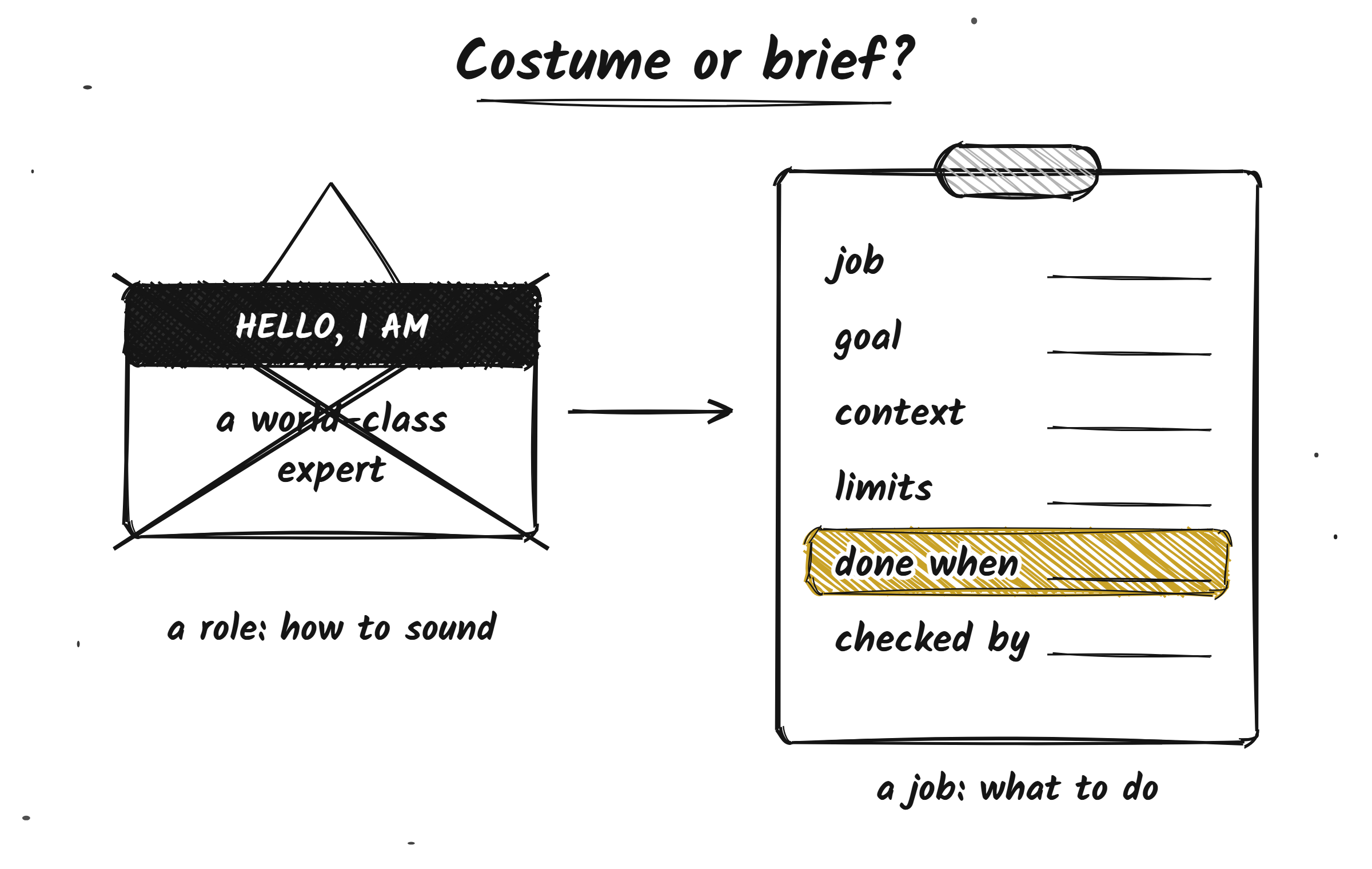
Two lines carry most of the weight. "Done when" is the line a costume never has. For the invoice agent, it's what stops a near-match from slipping through as a match. "Checked by" keeps the agent from signing off on its own work. Rieseberg is blunt about that one: "Do not ask the model to judge itself" [4].
None of this came out of nowhere. In March I wrote about an Acceptance Criteria Contract that already asked for an objective, constraints, and a way to validate the work. In September I swapped my agents' rulebooks for goals. What's new is putting all of it where the job title used to be.
A line in a brief guides the agent, but it isn't a lock. Anything that must never happen needs a hard stop in the system itself. Think of an approval step, or a permission the agent simply doesn't have.
Your agent doesn't need a job title. It needs a job.
Keep the persona only where it carries a method.
The strongest pushback is fair, and it comes in two parts. The studies measured exam answers on older or smaller models, not agents doing real work. And the vendors still tell you to give your AI a role. Anthropic's guide says a role "focuses Claude's behavior and tone," and that "even a single sentence makes a difference" [5]. OpenAI's template still opens with a role, but defines it as "the model's function, context, and job" [1].
Both are true, and neither saves the costume. The role the vendors describe is a one-line job description, and that's fine. As for the evidence, I couldn't find a public study that tests a short role line on today's frontier systems. Nor one inside a real agent. So treat my case as a bet, and check it on your own work.
Here's a fair test. Take ten real tasks for one of your agents. Run each one twice: the brief alone, and the same brief with a role line. Have someone other than the model grade the answers blind. If the role line wins on what it's for without costing accuracy, keep it.
Even a library built around personality leans on the job. Agency Agents, a widely used open-source library of agent profiles, describes each agent as "a specialized expert with personality, processes, and proven deliverables" [6]. Two of those three are the job. I haven't seen a test that separates the personality from the rest. My bet is that the processes and deliverables do most of the work.
Where a persona does hold is voice, and the style results in that 2026 study point the same way [3]. Saira, my chief of staff, has a name and a personality that argues with me. In a September post about my agent team, I wrote about their temperaments: "None of that changes what they do. It changes what it is like to read them." Voice is welcome, as long as it never stands in for the job.
My own build has two kinds of agents, and the line runs between them. The specialists do the work, like my inbox and calendar agents, and they get a Goal Brief and no costume. The advisors are there to challenge my thinking, each one built around a well-known thinker. Their persona stays, as long as it carries that thinker's methods: the questions they ask and the tests they run. The voice comes second.
Carry the methods, not the mask.
Take the costume off, and the job shows.
Back to that afternoon. I had asked three AIs whether my agents should have fixed roles. They answered that question. None of them knew enough to write a single brief for me.
Rebuilding didn't mean more prompting. It meant fewer adjectives, and plain answers to three questions. What does this agent own? When is it done? Who checks it?
Picture the invoice agent again. Its brief never says it's an expert. It says what a clean match looks like, what to stop and ask about, and who looks over its shoulder every week. That brief is harder to write than a costume, because it makes you decide what good looks like.
I had walked into that afternoon with the wrong question. I asked who my agents should be. The question that mattered was what their job is, and only I could answer it. The same goes for yours.
The best prompt isn't a costume. It's a brief.
So which of your agents is still wearing one?
 Peter van Hees

References
[1] OpenAI, "Using GPT-5.5" (prompt guidance), OpenAI API documentation, accessed 21 October 2026. https://developers.openai.com/api/docs/guides/prompt-guidance?model=gpt-5.5
[2] Savir Basil, Ina Shapiro, Dan Shapiro, Ethan Mollick, Lilach Mollick, Lennart Meincke, "Prompting Science Report 4: Playing Pretend: Expert Personas Don't Improve Factual Accuracy," Wharton Generative AI Labs, December 2025. https://gail.wharton.upenn.edu/research-and-insights/playing-pretend-expert-personas/ (paper: https://arxiv.org/abs/2512.05858)
[3] Zizhao Hu, Mohammad Rostami, Jesse Thomason, "Expert Personas Improve LLM Alignment but Damage Accuracy: Bootstrapping Intent-Based Persona Routing with PRISM," arXiv:2603.18507, 19 March 2026. https://arxiv.org/abs/2603.18507
[4] Felix Rieseberg, "How to be more ambitious: A tutorial for humans with models," felixrieseberg.com, 13 October 2026. https://felixrieseberg.com/how-to-be-more-ambitious-a-tutorial-for-humans-with-models/
[5] Anthropic, "Prompting best practices," Claude Developer Platform documentation, accessed 21 October 2026. https://platform.claude.com/docs/en/build-with-claude/prompt-engineering/claude-prompting-best-practices
[6] msitarzewski, "Agency Agents" (README), GitHub, accessed 21 October 2026. https://github.com/msitarzewski/agency-agents
Further reading: Mingqian Zheng, Jiaxin Pei, Lajanugen Logeswaran, Moontae Lee, David Jurgens, "When 'A Helpful Assistant' Is Not Really Helpful: Personas in System Prompts Do Not Improve Performances of Large Language Models," Findings of EMNLP 2024. https://arxiv.org/abs/2311.10054