AI Didn't Invent Slop. It Can Clear It Away.
Everyone fears AI slop. The better job for an agent is taking things away, and deciding what counts as slop is yours. Put it in a Removal Brief: what goes, what comes straight to you, who checks the pile, and one rule: archive, never delete.

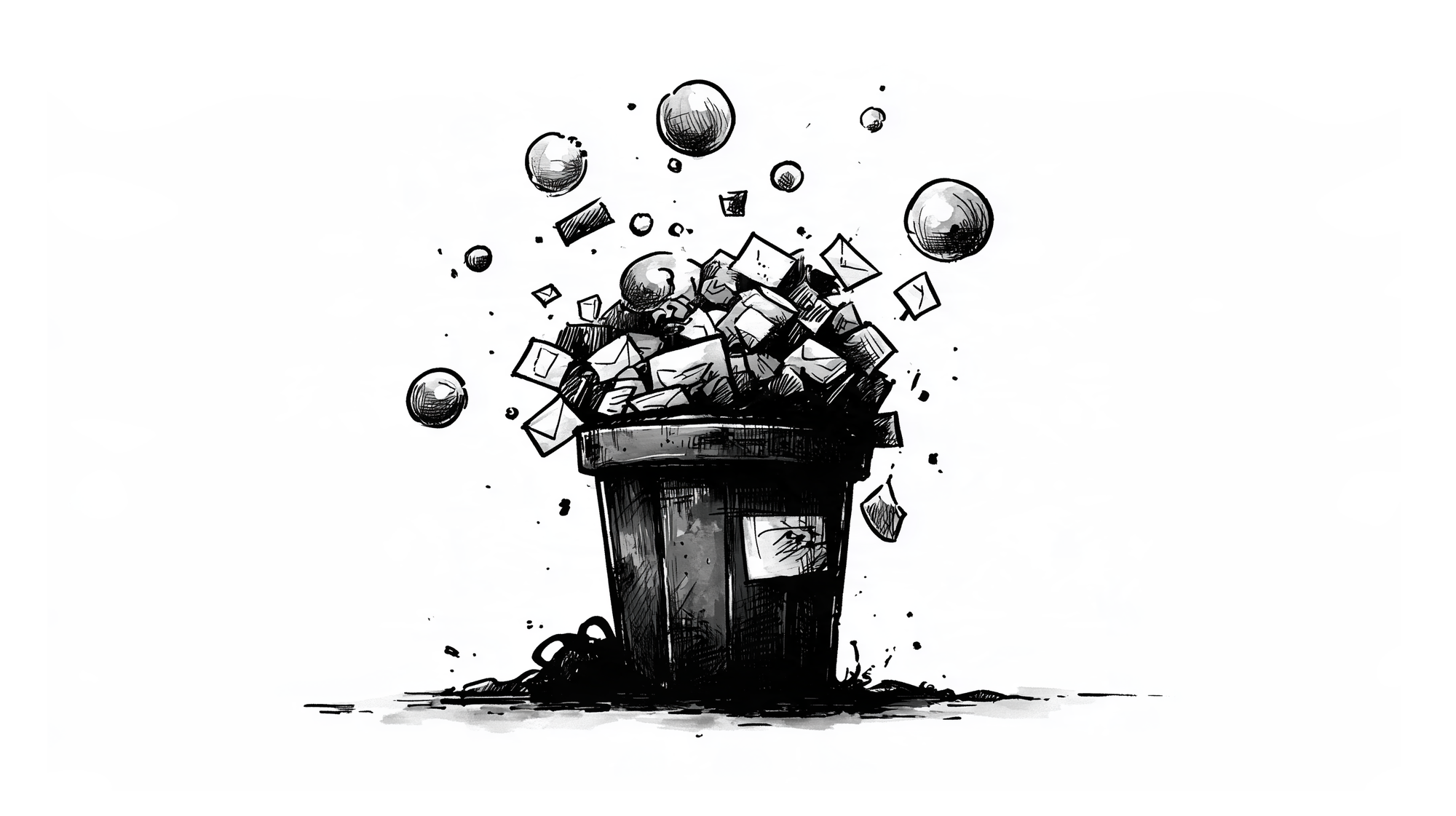
A developer's parents had to sit through a sponsored ad before their TV would let them reach Netflix. So in October he asked an AI agent to clean it up. The agent switched off the maker's preinstalled apps and built a clean home screen. Nothing was uninstalled, and one script puts everything back [1].
Most of the talk about AI right now goes the other way. Merriam-Webster, Australia's Macquarie Dictionary, and the American Dialect Society all made "slop" (Macquarie: "AI slop") their word of 2025 [2]. We worry about AI adding junk. This agent took junk away. That's a job most of us aren't giving our agents yet.
I believe the best job for an AI agent is often a removal job, because we're wired to add and we rarely think to take away. If you lead a team and you're drowning in your own inbox, an agent can do the clearing. By agent I mean an AI that acts instead of only answering. Deciding what counts as slop stays your job.
Most of the slop in your day was never made by AI.
Look closely at how Macquarie defines AI slop: low-quality content created by generative AI, often containing errors, and "not requested by the user" [2]. That last part is the real complaint. AI adds to that pile, and that's real. But most of what you never asked for arrived long before any chatbot did.
Take a TV maker that publishes its financial statements. In 2023 Vizio, a large American brand, sold its TVs and sound bars at a small loss. All of its gross profit, and then some, came from its software platform, which sells ads and viewing data [3]. On a set like that, the ad before Netflix is the product doing its job.
Somebody gets paid for that noise.
Your inbox runs on the same logic. The insurance promo. The meal-voucher newsletter. The shipping notice that only tells you a parcel is on its way. Each one gets sent because sending costs the sender almost nothing, and your attention costs them nothing at all.
Microsoft puts the average worker in its data at 117 emails a day, most of them skimmed in under a minute [4]. So you're already filtering. You're doing it by hand, a minute at a time, with the part of your day that should go to judgment.
Cleaning up that TV was always possible, if you had a developer's skills and a free weekend, so almost everyone put up with the ad. What changed this year is the price of taking things away. Now you can ask for the removal in plain language, and an agent does the work.
Riley Brown's video How Smart People Are Using AI Right Now collects a whole set of people doing exactly that, the TV among them [5]. Putting up with slop has become something we choose.
We're wired to add. So removal has to be someone's job.
In 2021 researchers published a study in Nature with an awkward finding. When people try to improve something, they default to looking for what to add, and so they overlook taking away. When a new university president asked for ideas, only about one in ten of the suggestions involved removing anything [6].
One of their tests used Lego. People had to change a small structure so it could hold a brick, and the simplest fix was to take one block off. Without a hint, most people didn't [6]. It isn't for lack of a reward, either. "Even with financial incentive, we still don't think to take away," says Leidy Klotz, one of the authors [6].
Now look at your company. Every report, meeting, tool, and newsletter in it was added by someone with a good reason. Almost none of them has an owner whose job is to take it out. Ask who is allowed to kill a weekly report. The answer is usually nobody, or everybody, which comes to the same thing.
Shopify once tried the opposite. In 2023 it let a bot clear every recurring meeting with three or more people off its calendars. Then it asked staff to be "really, really critical" about what they put back. The company says it removed 322,000 hours of meetings [7].
The machine cleared. People decided what came back.
That bot was simple code and a two-week wait. And the research studied people, so the leap to agents is mine. It's a short leap, though. An agent given a removal job does the search our brains skip. It has no attachment to the report it never wrote, and it doesn't need a reorganization as an excuse to clean up.
That makes removal a leadership decision. Your IT team can build the agent. Only you can say what your people should stop seeing.
A Removal Brief puts your judgment in writing.
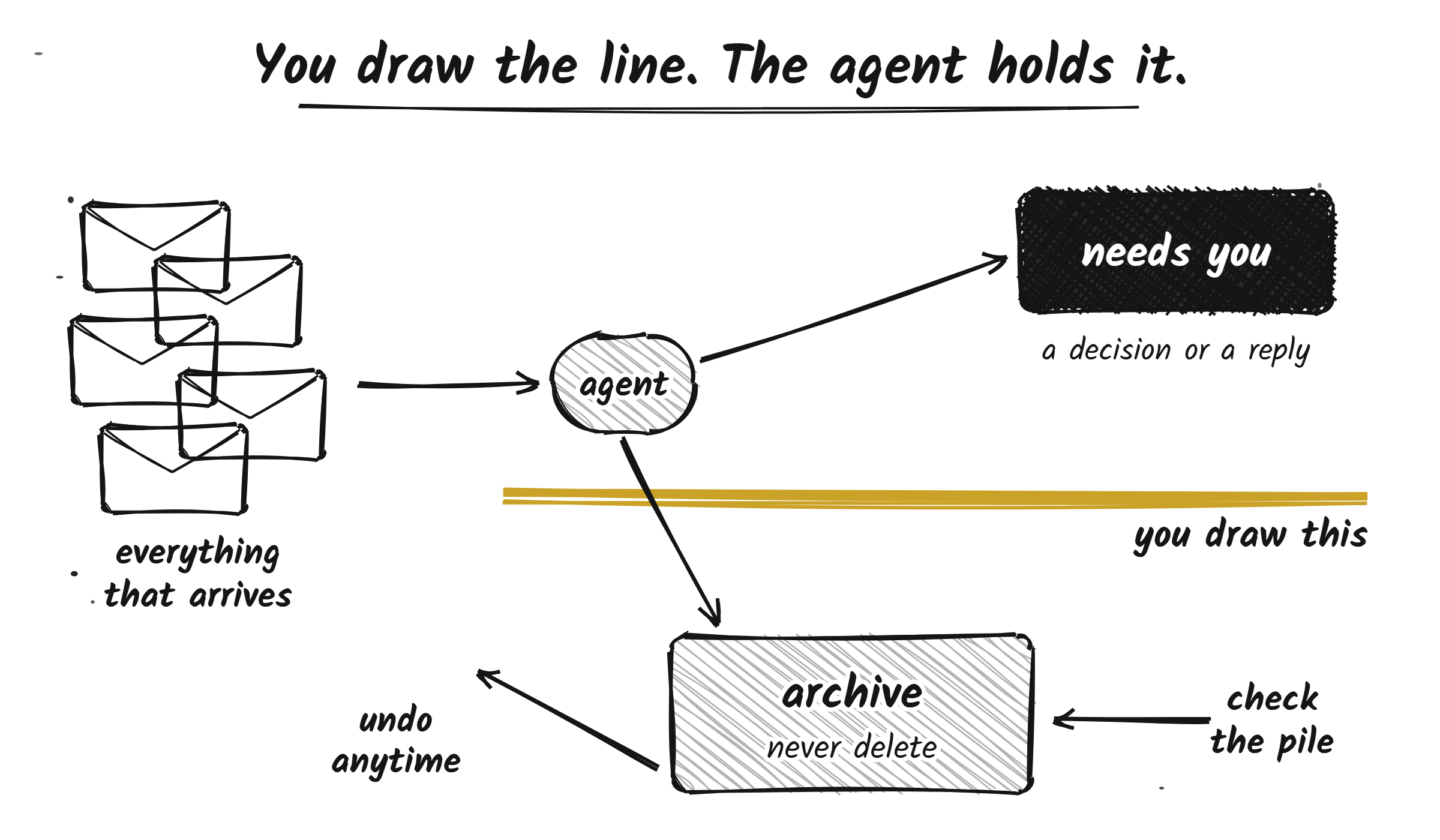
In my last post I argued for giving every agent a Goal Brief: a short job description instead of a persona. A job can also be to take something away. A Removal Brief is a Goal Brief for clearing: it tells an agent what to take away and what to leave for you. It has four parts:
- Slop: what counts, decided in writing, one stream at a time.
- Limits: archive, never delete, so every mistake can be undone.
- Surface: anything that needs a decision or a reply goes straight to a person.
- Checked by: someone looks at the pile now and then, so you see what the agent took.
Picture a team whose shared inbox drowns in vendor mail. Its Removal Brief could be this short, with one line on top that names the job:
JOB:        keep the team's shared inbox for work that needs a person
SLOP:       vendor promos, webinar invites, and newsletters nobody
            on the team has opened in a month
LIMITS:     archive, never delete. Never touch anything from a
            customer, an invoice, or a contract
SURFACE:    anything that asks a question or needs a decision
CHECKED BY: the team lead skims the archive every Friday
There's no clever prompt in it. Every line is a decision someone on the team made, and every line can be changed next week. The agent never has to guess what you value, because you wrote it down.
My own Inbox Agent works this way. It archives campaign mail and shipping notices that only carry a tracking date, under limits I approved one sender type at a time. Newsletters follow a goal: if I haven't opened one in a month, it gets archived. Policies, invoices, refunds, and anything that needs a reply come straight to me. It never flags or stars anything, and it can't send mail to anyone else.
Everything it does lands in a log I can check, and everything it takes sits in an archive I can still dig through. The embarrassing part? Many of those newsletters I signed up for myself. A good part of its job is cleaning up after a younger, more optimistic me.
You draw the line. The agent holds it.
You could fake part of this with old-fashioned mail rules. A rule matches a sender or a keyword. An agent can follow a goal like "newsletters I haven't opened in a month," and it can tell an invoice from a promo.
In September I wrote that every rule I added made my agent worse. For the work, I still believe that. In the same post I kept rules for boundaries, and "never touch an invoice" is a boundary.
If you want a starting point, these are the questions I'd start with:
- Would I ask for it today?
- Have I opened one in the last month?
- If it disappeared for a month, would I notice?
- Does it need a decision or a reply from me? Then it's never slop.
A filter you didn't define is someone else's feed.
You might think I've just described a new gatekeeper. If slop comes from business models, who pays for your agent? The big filters have a habit of turning into ad channels. Search did, and so did social feeds. And in February OpenAI began testing ads inside ChatGPT [8].
That objection is fair. Rent a filter from a company paid by someone else, with rules you can't see, and the slop is still there. It has just moved somewhere you can't inspect.
If you can't read the rules, it isn't your filter.
The objection falls away when the line is yours, in rules you wrote and can read. That's why my agent archives instead of deleting. And ask who pays for the agent, and who else gets to read what it reads. If it isn't you paying, ask what it's being paid to show you.
Apple learned the cost of handing the judgment to the machine. When its AI rewrote news alerts as short summaries, one summary announced that Luigi Mangione had shot himself. He hadn't. Apple paused the summaries for news apps [9].
A machine that decides what you see, in words you didn't choose, will get it wrong in public. A machine that holds a line you drew can only get it wrong in your archive, where you can fix it.
The hard part of that TV was never the code.
Back in that living room, his parents switch on the TV and land on a clean home screen. Nothing stands between them and Netflix anymore.
The agent did the fiddly part in an afternoon. The hard part came first. Their son looked at that screen and decided the ad was trash. No model made that call. It took knowing the people on that couch.
That's your job too. Every team has its own ad before Netflix: the report nobody opens, the meeting that outlived its reason, the vendor mail in the shared inbox. Your Monday can open as cleanly as that TV, once you decide what goes.
Agents can take out the trash. Only you can decide what trash is.
Pick one stream of noise you've stopped fighting. Decide what's trash in it, then give one agent one job this week: carry it out.
 Peter van Hees

References
- Tushar Mehta, "Fed up with ads and bloatware on your smart TV? People are vibecoding ways to remove them," Android Authority, 20 October 2026, https://www.androidauthority.com/android-tv-vibe-hacking-remove-ads-bloatware-3725338/ ; Gathin23 (Gathin T.), cleanyourtv (project README), GitHub, accessed 24 October 2026, https://github.com/Gathin23/cleanyourtv
- Macquarie Dictionary, "Macquarie Dictionary Word of the Year for 2025," 24 November 2025, https://www.macquariedictionary.com.au/macquarie-dictionary-word-of-the-year-for-2025/ ; Lucas Ropek, "Merriam-Webster names 'slop' the word of the year," TechCrunch, 15 December 2025, https://techcrunch.com/2025/12/15/merriam-webster-names-slop-the-word-of-the-year/ ; "ADS 2025 Word of the Year (WOTY)," Wordorigins.org, 10 January 2026, https://www.wordorigins.org/harmless-drudge/ads-2025-word-of-the-year-woty
- VIZIO Holding Corp., Form 10-K for the fiscal year ended 31 December 2023, U.S. Securities and Exchange Commission. https://www.sec.gov/Archives/edgar/data/1835591/000183559124000011/vzio-20231231.htm
- Microsoft WorkLab, "Breaking down the infinite workday," Work Trend Index Special Report, 17 June 2025. https://www.microsoft.com/en-us/worklab/work-trend-index/breaking-down-infinite-workday
- Riley Brown, "How Smart People Are Using AI Right Now (7 Insane Use Cases)," YouTube. https://www.youtube.com/watch?v=4PO0x-myitw
- Gabrielle S. Adams, Benjamin A. Converse, Andrew H. Hales, and Leidy E. Klotz, "People systematically overlook subtractive changes," Nature 592, 258-261, 7 April 2021, https://doi.org/10.1038/s41586-021-03380-y ; Tom Meyvis and Heeyoung Yoon, "Adding is favoured over subtracting in problem solving," Nature 592, 189-190, 2021, https://doi.org/10.1038/d41586-021-00592-0 ; Leidy Klotz, "Subtract: Why Getting to Less Can Mean Thinking More," Behavioral Scientist, 12 April 2021, https://behavioralscientist.org/subtract-why-getting-to-less-can-mean-thinking-more/ ; University of Virginia School of Engineering and Applied Science, "Why our brains miss opportunities to improve through subtraction," ScienceDaily, 7 April 2021, https://www.sciencedaily.com/releases/2021/04/210407135801.htm
- Andrea Hsu, "Shopify deleted 322,000 hours of meetings. Should the rest of us be jealous?," NPR, 15 February 2023 (republished by OPB). https://www.opb.org/article/2023/02/15/shopify-deleted-322000-hours-of-meetings-should-the-rest-of-us-be-jealous/
- Jared Perlo, "OpenAI starts testing ads in ChatGPT," NBC News, 9 February 2026. https://www.nbcnews.com/tech/internet/openai-starts-testing-ads-chatgpt-rcna258242
- Kif Leswing, "Apple disables AI notifications for news in its beta iPhone software," CNBC, 16 January 2025 (via NBC New York). https://www.nbcnewyork.com/news/business/money-report/apple-disables-ai-notifications-for-news-in-its-beta-iphone-software/6110884/