From AI Working on You. To AI Working for You.
Don't ask how smart it is. Ask whose side it's on. For years the smartest AI you met was working on you. Now you can point it at the world, if you first check who it answers to.


You bought the running shoes on Tuesday, and by Friday the internet was still trying to sell you the same pair. It felt haunted. The ghost followed you onto the news site and into your feed, then sat between two videos you didn't choose, now with a discount. The machine knew your size and the hour you like to shop, and it still couldn't tell you were done.
That looks like a clumsy algorithm. It's actually a very good one, working for somebody else. This autumn the big platforms started putting personal agents in ordinary people's hands, mostly in the US first. For the first time, the same kind of AI that was pointed at you can be pointed by you.
If you're about to hand real errands to an agent, for yourself or for your team, I believe one question comes first. Don't ask how smart it is. Ask whose side it's on. Otherwise you'll hand your judgment to the same kind of machine that spent years working on you.
The smartest AI you met was working on you
Start with the shoes, because they weren't a glitch. Google's own help page says remarketing lets advertisers "show ads to customers who have previously visited your website or used your mobile app," including ads for the products they viewed [1]. The pair that followed you all week was the product doing its job. It just wasn't your job.
Follow the money and you can see which way the machine points. Nearly every dollar Meta took in during 2025 came from advertising [2]. When almost all the money comes from advertisers, the product is built to serve them, and the feed you scroll is part of that product. The feed isn't broken. It's loyal, just not to you.
For most of your time online, this was a contest with one side armed. The platforms had the money and the engineers to aim learning machines at your attention. You had an ad blocker and a vague sense of being watched. Nobody built a machine that studied the world on your behalf, because nobody was paying for one.
Doc Searls saw this early. He has argued for years that customers, not advertisers, should drive markets, and he calls it the intention economy. His line on AI that belongs to someone else is the sharpest I know: "It may be personalized, but it is not personal" [3].
Being known is not being served.
That's push mode: AI working on you. This year, the arrow started to turn around.
Now you can send it hunting
Flip the arrow and you're in pull mode. Instead of a machine studying you so it can sell to you, you give it your list and send it out. Find me the best car for a family of four, under my budget. The adapter that finally runs my laptop and two screens. The laptop that fits how I really work. It comes back with picks, and with reasons.
The clearest proof I've seen this autumn is the same flip, applied to a video feed. At the end of October, the AI researcher Andrej Karpathy wrote about YouTube's recommendations: "I'm sure this algorithm works well for the median person on the internet, but it definitely does not work for me" [4].
So he had Claude build his own version, in about two hours, by his own account. He calls it HackerTube: videos that Hacker News readers have recommended, with suggestions that live in your own browser and no account to log into. The gap in money and manpower that kept you on the receiving end just got a lot smaller.
He didn't delete the algorithm. He took ownership of it.
It's still a crowd's taste, but he picked the crowd and set the goal. Then he published the data "to give to your agent to easily create your own version" [4]. You don't have to build anything; the next person starts where he stopped. That's what "pointed by you" looks like in practice: the same kind of machine that studied you, sent out with your list instead of someone else's.
This is real, and it's early. Today's agents find, compare, and fill the cart, and they mostly hand the last step back to you. So delegate the search now, and keep the buy button until the agent has earned it.
Start where the search is the hard part, like the supplier shortlist or the hotel near next month's conference. Those are the errands where an hour of tabs turns into one sentence and a short list.
Yes, agents can be bought
You might think this is the old machine with a friendlier face, and that agents are just the next ad channel with a chat box. You'd have a point.
ChatGPT started testing ads in February. By October, people on its free and low-cost plans in 89 countries were seeing them, and OpenAI says the ads don't influence the answers [5]. The business model inside the assistant you use is being settled this year, and quickly. If you're on a free plan, you're on the side of the line where the ads are.
Since mid-December 2025, Meta has used what people say to its AI assistant to choose the ads they see, with no way to opt out [6][7]. When it started, people in the EU, the UK, and South Korea were left out. So an AI that talks like a helper can still be part of the machine working on you. If you live in one of those places, you were spared at launch; don't read that as a promise.
In a 2024 lab test, Harvard researchers showed that a carefully crafted line of text on a product page could push a made-up product to the top of an AI's recommendations [8]. A seller doesn't have to pay your agent to lean on it. It only has to write for it.
In my book I wrote that an agent can't be marketed to. I was too optimistic. The money is already moving, and a hunter you send out can be bribed.
Agents can be marketed to. That's the fight.
But look at what that proves. Some agents will be captured. It doesn't prove they all will be, or that you can't tell which ones are. A feed could sell your attention without ever telling you. An agent that does it still answers to someone who can ask, and who can walk away.
This year the makers split in public: OpenAI sells ads and says they stay out of the answers [5], while Anthropic promised to keep its assistant ad-free and to explain itself if that ever changed [9]. Both are promises, and either can be revised.
They're visible, and they differ, which makes an agent's side something you can check and choose, while the defaults are still being set. The cynic says every agent will be bought, so why bother. The optimist says the good ones will win on their own. The cynic and the optimist both let someone else decide.
Allegiance is something you can check
Most launches sell you on how smart the agent is. Few tell you who it answers to. Yet a brilliant agent working for someone else is worse than a modest one working for you, because it's better at the wrong job.
In January I argued that the real battle is for your agent's allegiance. Here's the practical version. I call it the Allegiance Test: four checks to run on any agent before you hand it an errand. Pay. Obey. Show. Go.
- Pay. Who pays for it? An agent funded by whoever wants to reach you will lean their way. One you pay for, or one whose sponsors are disclosed and kept apart from its picks, has a reason to lean yours.
- Obey. Whose instructions win when they clash? Your list should beat the seller's goal, and the agent should tell you when it can't meet your list. Ask for no leather, and a sponsored leather pair shouldn't sneak in at the top.
- Show. Can it show its reasons? "Recommended for you" tells you nothing. "This pair fits your requirements, and that one was dropped because it runs narrow" tells you plenty. Ask it why the runner-up lost. If you sell things, this is your new shelf: your product has to survive an agent asking why.
- Go. Can you leave with your memory? Your preferences should come with you when you switch agents. If it can't hand you what it knows about you, you're renting your own history. Memory is just text only if you hold the text.
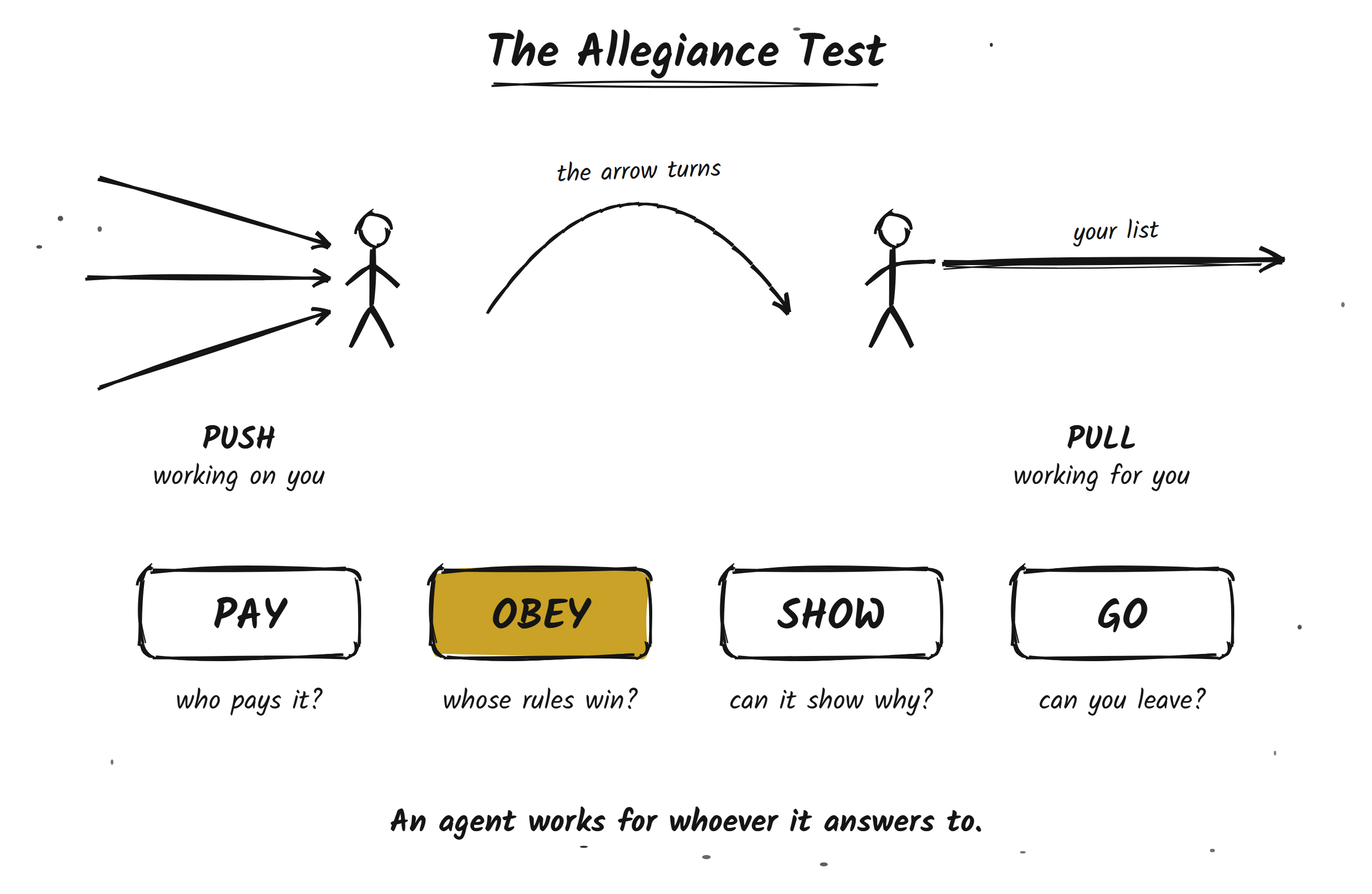
If you remember one check, make it Obey. Pay tells you who might pull on the agent. Show tells you whether you'd notice. Obey is where it counts: the moment your list and someone's money point in different directions, and only one of them can win.
Run Obey this week on the agent you already use most. Give it one firm rule, like a price ceiling or a brand you never buy, and ask for its picks. Then ask what it left out, and why. If a sponsored pick breaks your rule, or it can't tell you what it dropped, it failed.
None of these checks is proof. A captured agent can give plausible reasons, and any pledge can change. Still, you can now ask questions you could never put to a feed, and the answers can decide which agent gets the errand.
An agent works for whoever it answers to.
You already run this test on people. You'd ask a financial adviser how they get paid before you took their advice on your pension. Ask your agent the same, before it touches your money. If you lead a team, ask it of every agent that will spend company money, because each one makes many small choices in your name. That's a leadership call, not an IT setting.
The same errand, pointed the other way
Your shoes wear out again. This time you tell your agent what you need: wide fit, trail, under your budget, and nothing other runners say falls apart within six months. It comes back with two pairs and one question. "Your last pair wore through at the left heel. Should I only look at shoes with a reinforced heel?"
It mentions a third pair that's sponsored, and why it didn't make your list. You pick. The note about your left heel stays yours, whichever agent you use next. Nothing follows you around the internet afterward, because you never went looking. Your agent did.
Three weeks later there's one follow-up, and it comes from your own agent. Do they fit?
The AI used to hunt you. This time, you sent the hunter.
From AI working on you. To AI working for you. You set the list and made the call. The agent did the legwork, and it never forgot whose errand it was running.
Decide whose side your next agent is on, before someone else decides it for you.
 Peter van Hees

References
- Google, "About dynamic remarketing: show ads tailored to your site and app visitors," Google Ads Help. https://support.google.com/google-ads/answer/3124536
- Meta Platforms, "Meta Reports Fourth Quarter and Full Year 2025 Results," Meta Investor Relations, 28 January 2026. https://investor.atmeta.com/investor-news/press-release-details/2026/Meta-Reports-Fourth-Quarter-and-Full-Year-2025-Results/
- Doc Searls, "What Makes an AI personal?," Doc Searls Weblog, 6 February 2025. https://doc.searls.com/2025/02/06/what-makes-an-ai-personal/
- Andrej Karpathy, "HackerTube," karpathy.bearblog.dev, 31 October 2026. https://karpathy.bearblog.dev/hacker-tube/
- CNBC, "OpenAI expands ChatGPT Ads to 26 new countries as diversification push accelerates," 21 October 2026. https://www.cnbc.com/2026/10/21/openai-chatgpt-ads-26-countries.html
- Meta, "Improving Your Recommendations on Our Apps With AI at Meta," 1 October 2025. https://about.fb.com/news/2025/10/improving-your-recommendations-apps-ai-meta/
- The Register, "Meta will listen into AI conversations to personalize ads," 1 October 2025. https://www.theregister.com/2025/10/01/meta_ai_use_informs_ads/
- Aounon Kumar and Himabindu Lakkaraju, "Manipulating Large Language Models to Increase Product Visibility," arXiv:2404.07981, April 2024. https://arxiv.org/abs/2404.07981
- Anthropic, "Claude is a space to think," 4 February 2026. https://www.anthropic.com/news/claude-is-a-space-to-think