Your GUI Is a Tax on AI * The Emergent Interface
Static GUIs consume 80-99% of AI Agent token costs. The Emergent Interface replaces them with agent-assembled surfaces governed by a UI Constitution. This article exposes the economic case and gives you the three-part governance framework.

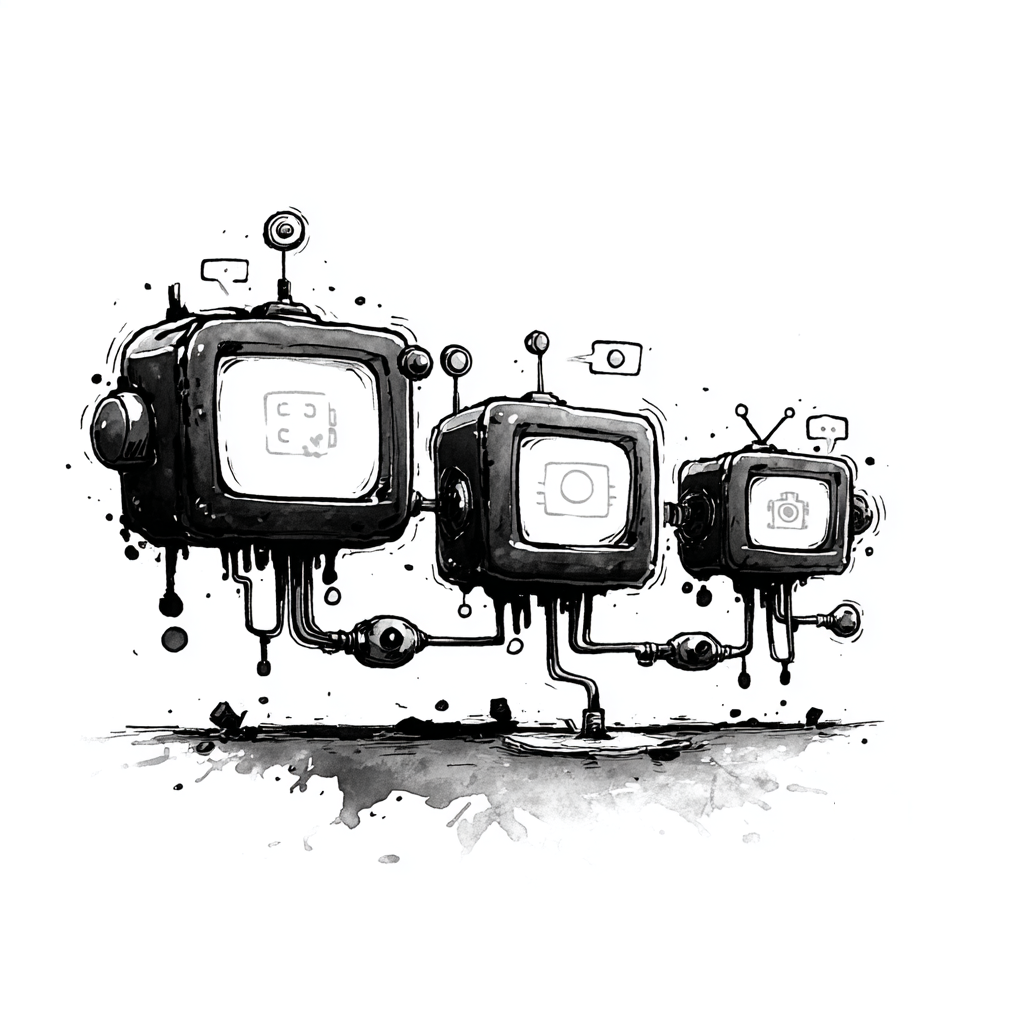
Your design system has become the most expensive bottleneck in your product. Every pixel-perfect component your team ships forces an AI Agent to burn 80% to 99% of its token budget just to read the interface it is trapped inside [1]. You are not building a product. You are building a tax. The Emergent Interface is the architectural successor, and it is already in production.
This article exposes the economic case against the static graphical user interface (GUI), introduces the Emergent Interface as its successor, and gives you the three-part governance framework, the UI Constitution, that separates controlled evolution from generative chaos.
The GUI on Trial * Your interface is a liability
I call the GUI a Grossly Underperforming Instrument, and the evidence supports the indictment. A 2025 arXiv study measured the computational cost of forcing AI Agents to parse traditional interfaces: UI representation alone consumes 80% to 99% of total agent token usage [1]. That is not a rounding error. That is a system designed to hemorrhage compute on the task of reading buttons.
The human cost is equally damning. Employees toggle between apps over 1.200 times per day. They lose five hours per week to context switching [2]. Across the US economy, that friction drains $450 billion annually [2]. After each interruption, workers need 23 minutes to refocus on their original task [2]. Your users are not multitasking. They are drowning.
I named this force the Tyranny of the Tap in my book AI Agents: They Act, You Orchestrate. The Tyranny of the Tap is the cumulative cognitive cost imposed by interfaces designed for human fingers, not human intent. Every tap, swipe, and menu-dive is a micropayment of focus surrendered to an architecture that profits from friction. The entire GUI paradigm is a strategic bottleneck, and you are paying for it in attention, compute, and dollars.
The defense has no case. The GUI is guilty.
The Emergent Interface Is Already in Production * The replacement is here; your debate is over
The Emergent Interface is an agent-assembled, context-driven surface that materializes on demand and dissolves when the task is done. It replaces the static, pre-built application with a living surface generated from your context, not your clicks.
This is not a concept deck. Google shipped the Agent-to-User Interface (A2UI) protocol in December 2025 [3]. A2UI is an open-source standard that lets AI Agents describe interfaces. Host applications render them using native UI components. The agent streams updates and refines the interface as the user interacts. No static screen. No pre-built layout. The interface emerges from the conversation between agent and context.
Vercel's AI SDK has crossed 20 million monthly downloads [4]. That number represents developer adoption at a scale that moves markets. The SDK added an agent abstraction layer and production-ready tooling for interfaces that generate themselves. When 20 million monthly downloads converge on a single architectural pattern, the question of whether is settled. The only question left is how well.
I define the Emergent Interface as the successor to the static screen: a just-in-time environment that exists only long enough to translate intent into outcome. The precursors you have seen, chatbot panels bolted onto existing dashboards, copilot sidebars that autocomplete within the old paradigm, are half-measures. They dress the cage in new colors. The Emergent Interface dissolves the cage entirely.
Why Does Generative UI Fail Without Governance? * The trust ceiling your users will hit
Here is the counterargument you are already formulating: generative interfaces are unpredictable. Users will lose trust. You are correct, and the data quantifies exactly how correct you are.
Trust in generative UI plateaus at 95% [5]. You can push adoption rapidly to about 50% user trust, then grind toward 90% to 95%, but the final gap to the certainty of static screens never closes. The Nielsen Norman Group's 2026 UX report identified a core failure: teams shipping AI-generated UIs without user validation, choosing speed over insight [6]. Excessively changing layouts disorient users. Fluidity without governance produces friction, the very problem the Emergent Interface was built to solve [7].
The counterargument validates the prosecution. Every trust failure, every disoriented user, every shipped-without-testing disaster is an exhibit for the UI Constitution.
I envisioned the UI Constitution framework as the governance layer that the industry is missing. The UI Constitution is the set of rules that constrain an agent's generative power so that every interface it creates stays coherent, purposeful, and aligned with your brand. Strip those rules away and you get chaos. Enforce them and you get controlled emergence.
The UI Constitution has three articles:
- The Brand Protocol is the set of non-negotiable design constraints (color palette, typographic scale, layout grid, tone of voice) that preserve your aesthetic identity across every generated surface. The agent generates freely within those boundaries. Your designer's role shifts from drawing screens to curating the system's taste.
- The Interaction Model is the codified physics of user experience: the allowed inputs, confidence thresholds for presenting actions, and graceful degradation paths when tasks fail. This is the architecture of predictable behavior inside a fluid surface.
- The State Mandate is the governance layer for interface memory: what context and user preferences persist across sessions so the experience stays coherent over time. Remove the State Mandate and every session starts from zero. The interface forgets your users as fast as they close the tab.
EY Studio already describes this shift as the move from pixel-pushing to intent architecture [8]. I put it more bluntly: the designer who writes the UI Constitution governs a thousand generated screens. The designer who draws mockups governs one.
How the Emergent Interface Changes Design Work * Constitution-writing replaces pixel-pushing
The Time-to-Outcome (TtO) Dividend is the metric that separates the old paradigm from the new. TtO Dividend is the measure of time and cognitive effort that an agent gives back to a user by eliminating friction between intent and outcome. A static GUI maximizes the distance between intent and outcome. An Emergent Interface, governed by a UI Constitution, collapses it.
Your design team's value has shifted. The question is no longer how many screens your team ships per sprint. The question is whether your team can write a Brand Protocol that governs a thousand generated screens, or whether they can only draw one at a time.
This is already the job market reality, not a forecast. EY Studio describes future designers as intent architects and experience strategists [8]. The UX Collective declares that the profession has entered the agentic era, where design means orchestrating AI Agent behavior, not arranging interface elements [9]. David vonThenen describes the ideal as Just-In-Time UI: interfaces that compose micro-surfaces on demand, hide when no longer needed, and shift modality between voice, glance, and touch based on the user's situation [10].
If you lead a product team, your competitive advantage lives in the constitution, not the component library. Any SDK can generate an interface. Only your team can encode the brand, interaction logic, and state intelligence that make the generated interface yours.
Why the Emergent Interface Is More Predictable * The old paradigm was the real chaos
Here is the reframe you did not expect. Everyone worries that emergent interfaces are too unpredictable. I argue the opposite.
The static GUI forced humans to context-switch 1.200 times a day across interfaces that ignored their intent [2]. That is not predictability. That is chaos dressed in consistent styling. The GUI delivered visual consistency at the cost of cognitive chaos. You always knew where the button was. You never knew if clicking it would get you what you actually needed.
The Emergent Interface, governed by a UI Constitution, is more precisely calibrated to the user's actual context than any static screen. The Brand Protocol ensures visual coherence. The Interaction Model ensures behavioral consistency. The State Mandate ensures continuity across time. The user gets an interface that knows their intent, instead of a static grid that forces them to translate intent into clicks.
Predictability was never a feature of the GUI. It was a constraint imposed by the limits of manual design. The UI Constitution delivers something the static screen never did: surfaces that are both adaptive and governed, both fluid and trustworthy.
Your Figma library is a fossil record of a paradigm that is dissolving. The Emergent Interface does not need your components. It needs your constitution. Write the rules, or the next generation of products will write them without you.
The Emergent Interface is one framework from AI Agents: They Act, You Orchestrate by Peter van Hees. The book maps 18 chapters across the full architectural shift from static screens to agent-driven reality, covering the Tyranny of the Tap, the AIOS Architecture that powers agent cognition, the Delegation Ladder that governs autonomy, and the Human Premium Stack that defines your durable value. If the gap between your design system and the Agent-First Era resonated, the book gives you the complete blueprint. Get your copy:
🇺🇸 Amazon.com
🇬🇧 Amazon.co.uk
🇫🇷 Amazon.fr
🇩🇪 Amazon.de
🇳🇱 Amazon.nl
🇧🇪 Amazon.com.be
References
[1] "From User Interface to Agent Interface: Efficiency Optimization of UI Representations for LLM Agents," arXiv, 2025. https://arxiv.org/html/2512.13438
[2] Qatalog, "App Switching and Enterprise Productivity," CIO Dive, 2022. https://www.ciodive.com/news/app-switching-enterprise-productivity-software-qatalog/602082/
[3] Google Developers Blog, "Introducing A2UI: An open project for agent-driven interfaces," 2025. https://developers.googleblog.com/introducing-a2ui-an-open-project-for-agent-driven-interfaces/
[4] Vercel, "AI SDK 6," 2025. https://vercel.com/blog/ai-sdk-6
[5] "The 95% Problem: The Trust Trade-off in AI-Generated UIs," Ikenna Newsletter, 2025. https://newsletter.ikenna.co.uk/p/the-95-problem-the-trust-trade-off-in-ai-generated-uis
[6] Nielsen Norman Group, "State of UX in 2026," 2026. https://www.nngroup.com/articles/state-of-ux-2026/
[7] Nielsen Norman Group, "Generative UI and Outcome-Oriented Design," 2025. https://www.nngroup.com/articles/generative-ui/
[8] EY Studio, "How agentic AI enables a new approach to user experience design," 2025. https://www.studio.ey.com/en_gl/insights/how-agentic-AI-enables-a-new-approach-to-user-experience-design
[9] UX Collective, "The agentic era of UX," 2025. https://uxdesign.cc/the-agentic-era-of-ux-4b58634e410b
[10] David vonThenen, "Invisible by Design: Context-Aware Interfaces that Assemble Themselves," 2025. https://davidvonthenen.com/2025/09/10/invisible-by-design-context-aware-interfaces-that-assemble-themselves/