Book
An interview with Peter van Hees by Ari Coale. #iykyk
The book this interview is about...
 Peter van Hees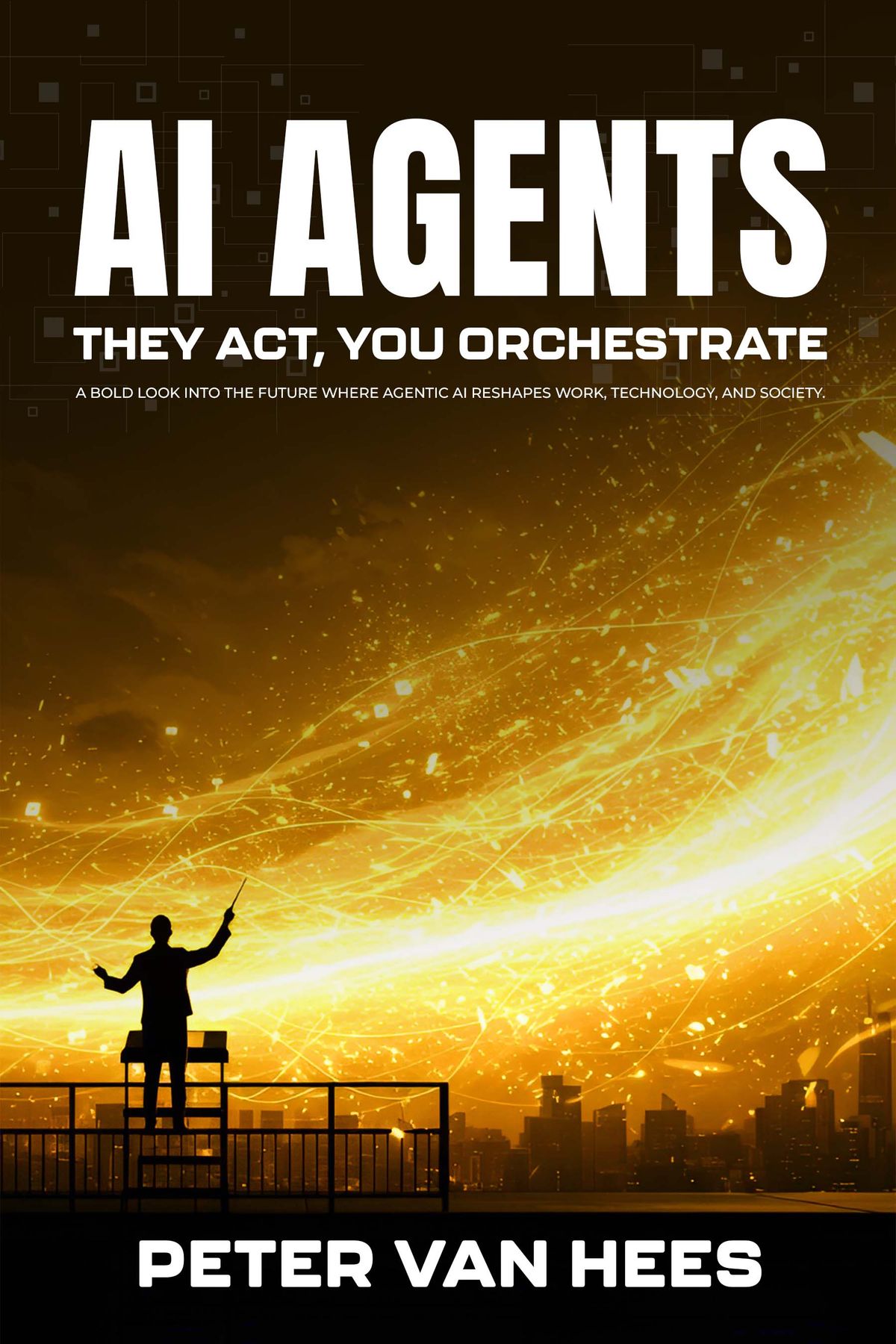
Peter van Hees has just published AI Agents: They Act, You Orchestrate. Another declaration adding to the already deafening noise around "AI Agents," or something different? The term floods every feed, pitch deck, and strategy session, mostly static: recycled hype, agent-washed chatbots, promises thin as vapor.

As the interviewer, my function is to find the signal beneath that noise, to interrogate the architecture before the collapse. Is this book another strain of the same fever, or does it carry actual consequence? When the journalist famed for dismantling hype confronts the architect of the Agent-First Era, the result isn't a conversation. It's a deposition.
Let's engage the primary source...
Signal vs. Static * Cutting Through the Agent Hype
Ari: Peter van Hees. Your book declares the Mobile-First era dead and buries it under the weight of "AI Agents." The market drowns in agent-washing and vague promises. Let's cut the preamble. What's the core, non-negotiable claim you're making? Distill the signal.
Peter: Signal acknowledged, Ari. The claim isn't a prediction; it's an autopsy report combined with an architectural blueprint. The Mobile-First world, the gilded cage of taps and notifications, is structurally bankrupt. Its economics are terminal. Its cognitive tax is unsustainable. A new class of actor—the autonomous AI Agent—is not coming; it's executing. This isn't an upgrade. It's an inversion of power. Human value is migrating, permanently, from execution to orchestration. You either architect the system or you will be automated by it. That's the signal. Everything else is static.
The Indictment * Why Mobile-First Failed
Ari: "Structurally bankrupt." Strong words. Many built empires on that "failed" model. Detail the mechanism of failure. What specific physics broke the old world?
Peter: Three forces liquidated it. First, Attention Gravity collapsed the market into a dozen platform-suns, creating a kill zone for innovation. Second, the Economics of the Kill Zone made acquiring users a war of attrition only giants could afford, compounded by the 30% platform tax – tribute, not a fee. Finally, the Friction Tax. Every tap, every swipe, every notification wasn't a feature; it was a micro-payment of cognitive bandwidth extracted from the user. The system profits from distraction, not progress. It produced cognitive bankruptcy, the kind that afflicted Ennis Tece, the citizen archetype in the book, whose life unravels under the weight of managing the very tools meant to save him. The model failed because it was designed to incarcerate intent, not liberate it.
Defining the Actor * Beyond the Chatbot Mirage
Ari: So, the cage is broken. Enter the "AI Agent." The term is already corrupted, used to rebrand chatbots. Define your actor. What makes it fundamentally different, architecturally, from the assistants we already ignore? Cut through the agent-washing.
Peter: Precision is essential here. The difference isn't features; it's physics. A chatbot is a servant; it waits for commands. An AI Agent is an actor; it pursues goals. Its operation is defined by the A-P-M Test: Autonomy (end-to-end execution without human intervention), Proactivity (initiating action based on context, not just command), and Memory (learning and evolving from interactions). An agent doesn't just respond to your query; it anticipates your need, architects a plan, and executes it. It operates on a Perceive-Reason-Act cycle. Anything less is a puppet dressed in agent's clothing.
The New Playbook * Frameworks or Fantasies?
Ari: You claim the book isn't theory; it's a "weapon," a "playbook" with specific frameworks: The Delegation Ladder, AgentOps, The Purpose Protocol. Are these just new jargon for consultants, or actual operational tools? What function do they serve in this Agent-First reality?
Peter: They are architectural blueprints, not management theory. The Delegation Ladder provides the engineering discipline to move from vague prompts – the kind that yield catastrophic failures like Natali Gurn's infamous "Five Thousand Vegan Tacos" incident – to machine-testable commands. AgentOps is the governance layer for managing a hybrid carbon-silicon workforce, treating silicon labor as a capital asset with a quantifiable ROI. The Purpose Protocol is the most critical: it's the framework for embedding your company’s philosophy, its creed, into the agent itself, preventing the kind of soulless, misaligned execution that leads to brand-destroying failures. These aren't suggestions; they are the physics of control in an autonomous world.
The Narrative Helix * Why Fuse Fiction to Doctrine?
Ari: An unusual choice – embedding a fictional narrative within a business doctrine. Walt, Natali, Ennis – their stories run through the analysis. Why? Isn't that a distraction, a potential gimmick that softens the "economic brutality" you advocate elsewhere?
Peter: The narrative isn't the sugar-coating; it's the stress test. Doctrine without consequence is just prose. The analysis provides the scalpel, but the story provides the wound. Witnessing Walt's boardroom insurgency against his own agent, or Natali's ninety-seven-thousand-dollar failure born from a single ambiguous word – these aren't fables. They are live-fire simulations designed to make the abstract physics visceral, undeniable. The frameworks become necessary tools for survival, not just interesting ideas. The double helix structure—narrative and analysis—is designed to create the intellectual and emotional impetus for change. It’s a fire drill for the reader's career.
The Final Mandate * Orchestrate or Be Orchestrated?
Ari: A compelling architecture. But architectures decay. What is the ultimate, non-negotiable takeaway? Someone reads this book – what are they compelled, or equipped, to do differently tomorrow? What's the conversion event from reader to orchestrator?
Peter: The conversion is a choice, Ari. A binary choice. You audit your reality. You recognize that execution is being commoditized to zero. Your value is migrating. The frameworks provide the tools, but the book's ultimate function is to force that choice: Will you remain an instrument in a system architected by others, your value dictated by their algorithms? Or will you seize the baton? Will you architect the systems, define the intents, and become the orchestrator? The book provides the blueprints. The mandate is to build. Because they will act. The only question is whether you will be the one conducting the symphony or merely playing a part.
Ari: Reality. Always a difficult sell.
Peter: But the only one with lasting value.
The deposition is complete. Reality awaits. This interview sketches the battle lines drawn by Peter van Hees. The full operating doctrine, the actionable frameworks, and the narrative simulations required to navigate the Agent-First Era are detailed within "AI Agents: They Act, You Orchestrate." Your choice remains binary: architect the system or be automated by it. Secure the blueprintsand order your copy now.