Your App Redesign Is Already Obsolete * Zero UI Paradigm
Your designers spent months perfecting a screen your customers will abandon within two years. The Friction Tax costs knowledge workers 45-90 minutes per day. The Zero UI Paradigm dissolves the interface entirely, replacing taps with intent. Stop optimizing the cage. Architect the escape.

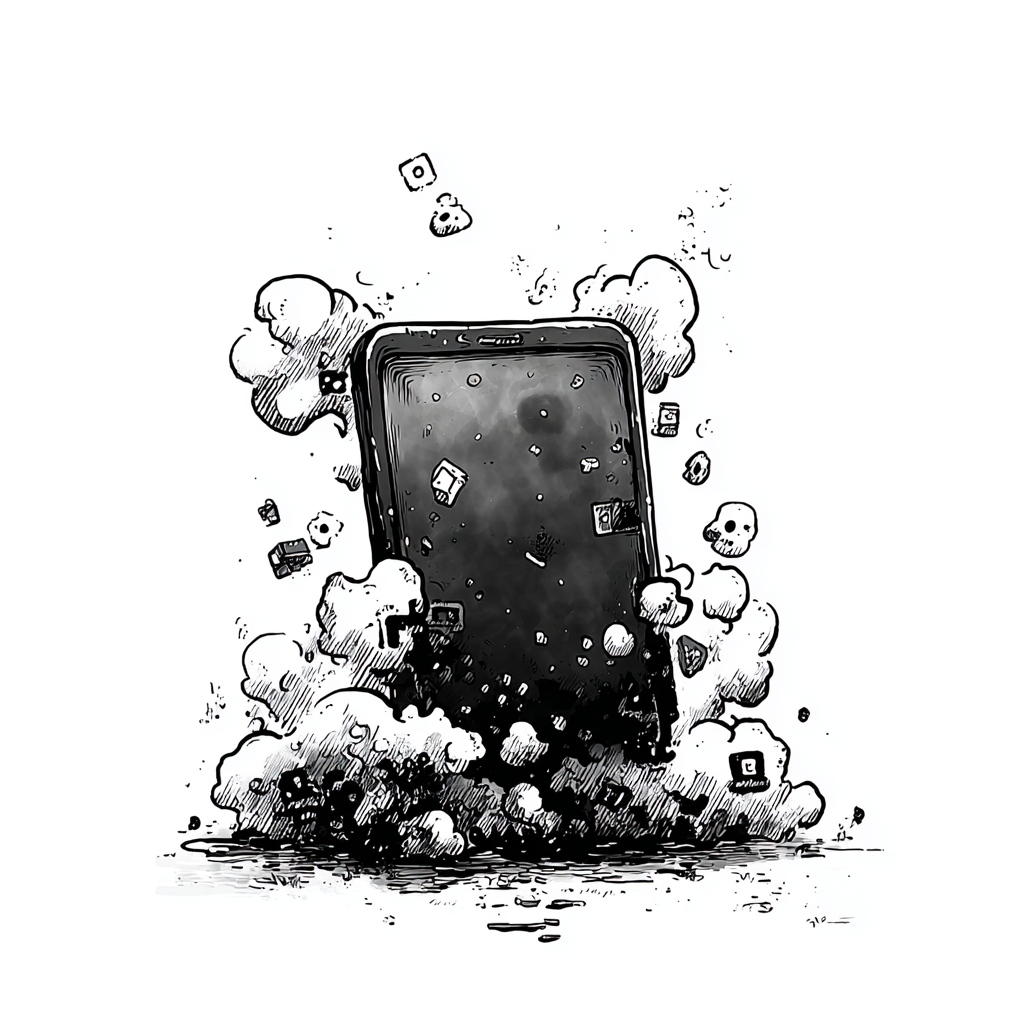
Your company's best designers spent months perfecting an interface your customers will abandon within two years. Gartner projects mobile app usage will decline 25% by 2027 [1]. The screen has always been the tax.
This article introduces the Zero UI Paradigm, the architectural shift in which the interface appears only when necessary, assembled just-in-time from context, then dissolved. I built this framework to explain why the graphical interface is a structural liability, what the Friction Tax costs your organization in hours and dollars, and how the fastest companies on the planet are dissolving the screen entirely.
Why Does Your Engagement Strategy Still Worship the Screen? * Your metrics measure imprisonment, not value
The graphical user interface (GUI) was a breakthrough in 1984. In 2026, it is a bottleneck. Every tap, every swipe, every context switch extracts a cognitive toll from your team, and the bill is staggering.
The average knowledge worker switches between applications 1.200 times per day [2]. Each interruption costs 23 minutes and 15 seconds of recovery time [2]. Microsoft's WorkLab research found employees face interruptions every two minutes [2]. The aggregate damage: 45 to 90 minutes of productive output evaporates daily from every knowledge worker on your payroll [2]. Across the global economy, McKinsey estimates the total productivity opportunity at $4,4 trillion [3].
The Friction Tax is the cumulative cognitive toll extracted by every tap, swipe, and context switch in a GUI-dependent workflow. The Friction Tax is a structural feature of the paradigm itself, immune to wireframe polish. You cannot reduce friction by optimizing the thing that creates it. That is like soundproofing a room by installing a quieter jackhammer.
Your engagement metrics compound the delusion. Session duration, daily active users, screens per visit: these do not measure value delivered. They measure how long your users stay trapped. The American Psychological Association found that interruptions as short as five seconds triple error rates [2]. Your polished, intuitive interface is actively generating errors.
What Is the Friction Tax Costing Your Organization? * The hemorrhage has a receipt, and you are paying it
Researchers at UC Irvine, Harvard, and Microsoft documented the productivity cost of context switching exhaustively. In Chapter 1 of my book AI Agents: They Act, You Orchestrate, I named the tax, assigned it a ledger, and prosecuted the system that collects it.
The Friction Tax compounds through three mechanisms.
- First, the cognitive recovery penalty: every app switch forces your brain to rebuild its working model of the task, costing 23 minutes of refocused attention [2].
- Second, that fragmented attention triples mistake rates, triggering additional correction cycles [2].
- Third, those 45 to 90 lost minutes per employee per day are minutes your competitor reclaims by deploying agent-driven workflows that bypass the GUI entirely.
The math is brutal. A 200-person knowledge-work organization losing 60 minutes per employee per day to the Friction Tax bleeds 200 hours daily. That is 52.000 hours per year. At a blended cost of $75 per hour, you are writing a $3,9 million annual check to the interface. And your board just praised the redesign.
The only honest metric for measuring technology's value is Time to Outcome, the TtO Dividend. The TtO Dividend is the quantifiable measure of human time and cognitive energy reclaimed from a task by an agent. It replaces engagement as the north star. It asks one question: how much life did we give back?
 Peter van Hees
Why Are the Smartest Companies Going Headless? * They are decoupling from the screen entirely
The evidence of an evacuation is visible to anyone willing to look. The headless commerce market will reach $11,8 billion by 2028, growing at 17,5% compound annual growth rate [4]. This is not a developer trend. This is capital fleeing the graphical user interface.
Headless architecture decouples the back-end engine of a service from the front-end presentation layer. It separates value from screen. Shopify and Salesforce are pushing headless solutions aggressively. Coca-Cola, HBC, and Sephora have re-architected their entire digital presence around it [4]. These companies are not chasing an aesthetic preference. They are building the scaffolding for a post-app world where agents access value through APIs at machine speed, while GUI-dependent competitors deliver at human speed.
Microsoft's Copilot has evolved from a chat assistant to what the company now calls an "operational AI layer," with its Security Copilot deploying "ambient and autonomous" agents [5]. Gartner projects 70% of all customer journeys will run through conversational AI by 2028. The direction is unanimous. The screen is becoming optional.
The causal chain runs three levels deep. Headless architecture decouples value from screen. Therefore, agents access that value without human tap-and-swipe mediation. Therefore, headless companies deliver outcomes at machine speed while GUI-bound competitors deliver at human speed. The TtO Dividend gap between these two camps widens every quarter.
What Does Zero UI Actually Mean? * Your life becomes the command line
Zero UI does not mean screens vanish forever. The primary interface becomes your intent, location, calendar, and biometric signals. Context replaces clicks. The Emergent Interface is the just-in-time assembly and dissolution of interface elements based on user context, as explored in Chapter 4 of AI Agents: They Act, You Orchestrate.
The consumer hardware is already here. The Bee wearable ($49) and Omi ($89) provide always-on ambient AI. Ray-Ban Meta Gen 2 glasses ($329 to $799) embed AI assistants in eyewear. The Plaud NotePin ($159) captures and transcribes voice. Lenovo's Qira Personal Ambient Intelligence System, announced at CES 2026, spans an entire device portfolio [6]. ElevenLabs is building the voice AI infrastructure layer that connects them all [7]. These are not prototypes. They are shipping products.
The Emergent Interface dissolves the static application and replaces it with a living surface generated from your context. Your calendar says you have a flight at 4PM. The airline's API reports a seven-hour delay. Your GPS fixes your position 45 minutes from the airport. An agent synthesizes these signals, rebooks the flight, updates your car service, and delivers a single confirmation to your earbud. You did nothing. Your context was the command.
As Deloitte's research team concluded: "The future brand is not a logo or interface; it is how a system behaves when no one is watching" [1]. Design expert Massimo Falvo put it sharper: "We will no longer design screens; we will design behaviors" [8].
Engineering Trust in a Zero UI World * Confidence scores replace the hollow satisfaction of the click
The legitimate objection to Zero UI is verification. When work happens invisibly, how do you confirm it happened correctly? This is a valid concern, and it has a precise answer.
Zendesk found that 58% of consumers revert to human assistance after a single financial error by an AI system [9]. Trust collapses fast when invisible systems fail. You cannot deploy Zero UI without engineering the trust architecture to support it.
In my book, I describe the Trust Blueprint, the framework for engineering confidence in invisible systems. Start with Confidence-Scored Confirmations: every agent output carries a calculated probability of accuracy, not a binary "done." A 99,7% confidence score gives you permission to disengage attention. A low score triggers human review.
Then architect for Graceful Degradation. When an agent encounters conflicting data or ambiguous intent, it executes what it is certain about and escalates what it is not. It does not crash; it narrows.
Finally, deploy Multimodal Handoffs. Confirmations must match the cognitive weight of the information to the right sensory channel. A successful low-risk payment is a haptic buzz on your wrist, not a screen notification that hijacks your focus.
The companies that win the Zero UI transition will be the ones that build the best confidence-scoring frameworks. Screen quality becomes irrelevant when the screen itself is optional. Trust is the new interface.
Your Job Description Just Inverted * The pixel-pusher era is over; the Orchestrator era has arrived
Most readers reach this point expecting a eulogy for the UX profession. I have the opposite argument. If you are a VP of Product or a Head of UX, your role is inverting. That inversion makes you more valuable than you have ever been.
For 20 years, your team designed surfaces: pixels, wireframes, interaction flows. In the Zero UI Paradigm, you architect the invisible: trust frameworks, confidence-scoring systems, context models, intent-to-outcome pipelines. The skills that made you effective, deep understanding of user intent, empathy for cognitive load, obsession with reducing friction, those skills are now the load-bearing walls of the entire Agent-First Era. The delivery mechanism changes. The architectural instinct does not.
I call this the Command Inversion, the shift in which the user graduates from frantic clerk to Orchestrator, and the agent becomes the actor. The designer becomes the architect of the system that connects them. Your expertise in understanding what users want is the scarcest resource in a world where execution is commodified. The question is whether you deploy that expertise against pixels or against the architecture of intent.
The Friction Tax does not negotiate. The TtO Dividend does not wait. The interface is dissolving. You will architect the invisible on your terms, or you will watch your competitor architect it on theirs.
The Zero UI Paradigm is one framework from one chapter of AI Agents: They Act, You Orchestrate by Peter van Hees. The book maps 18 chapters across the full transition from the Mobile-First Era to the Agent-First Era, from the Delegation Ladder that governs how you command agents, to the Human Premium Stack that defines what work remains yours, to the Deliberate Friction Framework that prevents cognitive atrophy when everything becomes invisible. If the Friction Tax resonated, the book gives you the complete architectural blueprint. Get your copy:
🇺🇸 Amazon.com
🇬🇧 Amazon.co.uk
🇫🇷 Amazon.fr
🇩🇪 Amazon.de
🇳🇱 Amazon.nl
🇧🇪 Amazon.com.be
References
[1] Deloitte Luxembourg, "When interfaces vanish, trust must become visible," Deloitte, December 2025. https://www.deloitte.com/lu/en/our-thinking/future-of-advice/designing-trust-in-a-world-of-invisible-interfaces.html
[2] BasicOps, "The Hidden Cost of Context Switching," BasicOps, 2025. https://www.basicops.com/cb-articles/the-hidden-cost-of-context-switching-cc4za
[3] McKinsey & Company, "AI in the workplace: A report for 2025," McKinsey, 2025. https://www.mckinsey.com/capabilities/tech-and-ai/our-insights/superagency-in-the-workplace-empowering-people-to-unlock-ais-full-potential-at-work
[4] Lidia Commerce, "Headless Commerce in 2026: What is it & Why it Matters?" Lidia Commerce / PYMNTS, 2026. https://www.lidiacommerce.com/blog/headless-commerce-in-2026-what-is-it-why-it-matters
[5] Microsoft, "6 core capabilities to scale agent adoption in 2026," Microsoft Copilot Blog, 2026. https://www.microsoft.com/en-us/microsoft-copilot/blog/copilot-studio/6-core-capabilities-to-scale-agent-adoption-in-2026/
[6] Plaud AI, "9 Life-Changing AI Wearable Devices in 2026," Plaud AI Blog, 2026. https://www.plaud.ai/blogs/articles/9-life-changing-ai-wearable-devices-in-2026
[7] Forbes, "Is Voice Becoming the UI Of The AI Era?" Forbes, February 2026. https://www.forbes.com/sites/stevenwolfepereira/2026/02/02/voice-is-the-ui-in-the-ai/
[8] Massimo Falvo, "Zero UI: The Invisible Future of Design in the Age of Artificial Intelligence," Medium, July 2025. https://medium.com/@max198/zero-ui-the-invisible-future-of-design-in-the-age-of-artificial-intelligence-e73cab8f976e
[9] Zendesk, consumer survey on AI error recovery, referenced in Deloitte (2025). https://www.deloitte.com/lu/en/our-thinking/future-of-advice/designing-trust-in-a-world-of-invisible-interfaces.html