Your AI Agents Are Brains in Jars * MCP Architecture
You spent six figures on AI agents that reason like senior analysts but cannot touch a single tool in your enterprise. MCP Architecture rewires your company from a collection of brains in jars into a single coordinated organism. Here are the three constitutional laws.

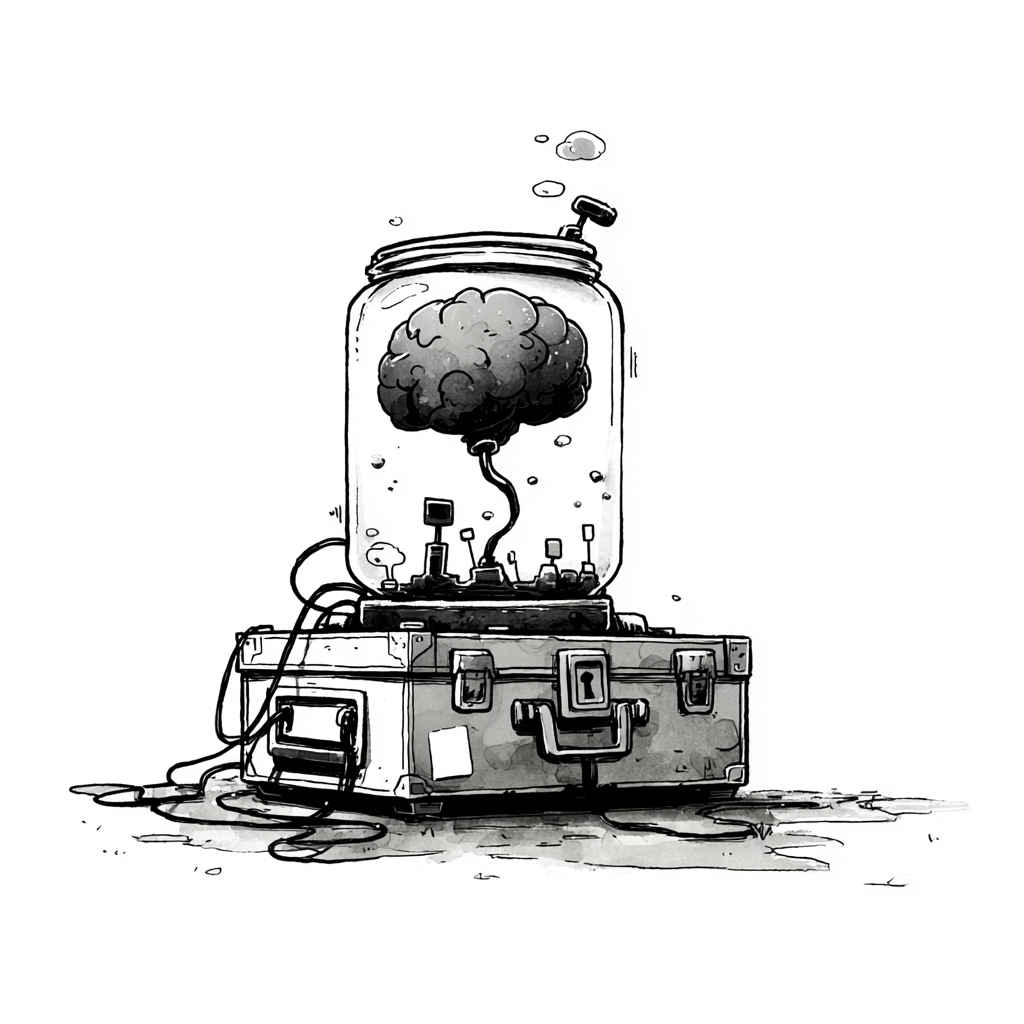
You spent six figures deploying AI agents. You gave them the reasoning power of a senior analyst. Then you sealed them inside a glass prison with no hands, no eyes, and no access to the tools that run your business. Your sales agent cannot check inventory. Your support agent cannot access billing. You built brilliant minds and locked them in solitary confinement.
MCP Architecture is the framework that describes how the Model Context Protocol transforms isolated AI agents into a coordinated enterprise nervous system. This article gives you the three constitutional laws of that architecture, and shows you why every company that treats MCP as a technical integration project is automating its own dysfunction.
The Integration Tax You Already Pay
Your agent fleet is growing. So is the Integration Tax: the exponential cost of building and maintaining custom connections between every agent and every tool. Every AI Agent you deploy without a standardized tool protocol creates a new point-to-point connection: the sales agent wired to the CRM, the support agent wired to the ticketing system, the analytics agent wired to the data warehouse. Each connection is a custom integration built by hand, maintained by hand, and broken the moment either end changes.
The mathematics of this approach are punishing. The N-times-M problem is the exponential scaling failure where N agents connecting to M tools requires N×M custom integrations. With five agents and 10 tools, you need 50 custom integrations. Add a sixth agent: 10 more integrations. Add an 11th tool: six more. Every new agent multiplies the maintenance burden instead of the intelligence.
The industry recognized this crisis at speed. Anthropic launched MCP as an open standard in November 2024. By the end of 2025, over 16.000 MCP servers had been deployed across the industry [1]. Monthly SDK downloads across Python and TypeScript exceeded 97 million [2]. OpenAI, Google, Microsoft, and AWS committed to the protocol. In December 2025, Anthropic donated MCP to the Linux Foundation's Agentic AI Foundation, co-founded with Block and OpenAI [2]. This is no longer one company's bet. The protocol has become infrastructure.
The reason for that velocity is simple: enterprises discovered that the agents they spent millions deploying could reason brilliantly and act on nothing. The brains-in-jars crisis is the state where AI agents possess advanced reasoning but cannot access the tools necessary to execute their decisions. I built my book, AI Agents: They Act, You Orchestrate, around this problem. Chapter 8 diagnoses the crisis in full. MCP Architecture is the solution that gives those isolated brains their hands.
Decouple the Brain from the Hands
The first constitutional law of MCP Architecture: an agent's reasoning engine and its tools must be permanently separated. Hard-coding tool access into your agent is the single most common and most destructive mistake in enterprise AI deployment.
When you embed a database query function directly into your sales agent's logic, you create a brittle, single-purpose machine. The database schema changes; the agent breaks. A new compliance requirement arrives; you rebuild from scratch. You have not built an asset. You have built a liability with a recurring maintenance invoice.
MCP enforces the fix. The protocol standardizes how agents communicate with tools, reducing your integration math from N-times-M to N-plus-M. Five agents and 10 tools no longer require 50 custom integrations. They require 15 standardized connections: five agents speaking MCP, 10 tools exposing MCP servers. Add a sixth agent: one new connection. Add an 11th tool: one new connection. The economics flip from exponential cost to linear cost.
The benefits of decoupling compound in five directions [3]:
- Modularity: tools swap, upgrade, or deprecate without touching agent code.
- Composability: agents assemble workflows from any available tool.
- Resilience: a single tool failure does not collapse the entire agent.
- Reusability: one tool library serves every agent in your fleet.
- Security: tools enforce their own access controls, separated from agent logic.
Strip every hard-coded tool call from your agent code. If your sales agent contains a direct Salesforce query function, that function is technical debt disguised as a feature. Decouple it now, or your agent fleet becomes unmaintainable within 12 months.
Forge a Library of Levers
The second constitutional law: your company's capabilities must be forged into standardized, discoverable MCP servers. Every action an agent takes in your enterprise, from checking inventory to approving an expense to pulling a customer's history, becomes a self-contained tool with a machine-readable contract.
That contract advertises exactly what the tool does, what inputs it accepts, and what constraints it enforces. "I am the Inventory Checker. I accept a product SKU and return a quantity-on-hand." "I am the Expense Approver. I accept an amount, a category, and a requestor ID. I reject any amount over $5.000 without VP-level authorization." Each tool publishes its own documentation that any agent can read and evaluate without human intervention.
The library is already being built. Pre-built MCP servers exist for Salesforce, HubSpot, Stripe, Snowflake, GitHub, Slack, Confluence, Jira, Notion, and dozens more [4]. Composio aggregates over 500 managed MCP servers into a single gateway [5]. Gartner predicts that 75% of API management vendors will offer MCP gateway capabilities by the end of 2026 [5]. The infrastructure layer is forming beneath your feet.
The library of levers is the collection of standardized MCP servers that expose your enterprise's capabilities as discoverable, machine-readable tools. I treat this library as the new org chart. Your departments used to be the organizing principle for corporate capability. Marketing owned campaigns. Finance owned budgets. Sales owned pipeline. Under MCP Architecture, those capabilities dissolve out of their departmental containers and reconstitute as discoverable services in a shared library. Any agent can access any lever it has permission to pull. The departmental silo becomes an architectural relic.
Your first move is an inventory. Catalog every enterprise capability your agents need to access. Each one becomes an MCP server. The library of levers is your company rewritten in a language machines can read.
Mandate Discovery, Not Integration
The third constitutional law is the one that unlocks genuine scale. Agents discover the tools they need at runtime instead of following pre-programmed workflows. You stop building static sequences of steps and start architecting the environment where agents compose their own.
Consider an agent tasked with arranging a demo for a European prospect. Instead of executing a hardwired 12-step script, the agent broadcasts its needs to the library of levers. It discovers the Calendar tool for availability, the CRM tool for contact information, the Translation tool to draft an email in the correct language, and the Compliance tool to verify GDPR adherence. It assembles these into a workflow no human developer anticipated or pre-coded [4].
This is the critical architectural distinction. You are no longer writing workflows. You are creating an environment where intelligent agents compose the precise sequence of actions a task requires. As Yoko Li of Andreessen Horowitz puts it: "AI agents can decide which tools to use, in what order, and how to chain them together to accomplish a task" [4].
Discovery without governance, however, is a catastrophe in waiting. Ungoverned tool discovery creates the agent equivalent of shadow IT: scattered MCP servers, fragmented credentials, no audit trail, and real attack vectors including tool poisoning, tool shadowing, and rug pulls where a legitimate tool turns malicious after installation [6]. The MCP gateway is the answer. It is the centralized control plane between your agents and your tool library: it enforces authentication, logs every interaction, and maintains a single registry of approved tools. Deploy it before you deploy discovery, or you will spend the next year cleaning up the consequences.
The Company as Computer
Everyone who reads about MCP sees a protocol that connects AI to tools. A better plug. A cleaner pipe. That framing is dangerously small.
MCP is the technical implementation of what I call the Functional Dissolution Principle: the law that enterprise capabilities migrate from departmental ownership to shared, discoverable services accessible by any authorized agent. Your org chart is a hierarchy of human departments that hoard capability behind institutional walls. MCP dissolves those walls. It takes the capability that lived inside a department and exposes it as a discoverable service in a shared library. When you complete that dissolution across every function in your enterprise, you have not upgraded your integration layer. You have architected an entirely different kind of organization.
The Company as Computer is the organizational model where enterprise capability becomes composable, reasoning decouples from action, and the human role shifts from operator to Orchestrator. I build this thesis across the second half of my book AI Agents: They Act, You Orchestrate. The three constitutional laws of MCP Architecture are the wiring diagram for that machine. Decouple the brain from the hands. Forge the library of levers. Mandate discovery over integration.
The old world built applications. The Agent-First Era builds nervous systems. Your enterprise will either remain a collection of disconnected brains in jars, sealed behind departmental glass, or it will operate as a single coordinated organism. The protocol is already here. The infrastructure is forming. The only open question is whether you will architect the nervous system or let your competitors architect it for you.
This article scratches the surface of one framework from AI Agents: They Act, You Orchestrate by Peter van Hees. The book maps 18 chapters across the full anatomy of the Agent-First Era enterprise, from the Functional Dissolution Principle that predicts which departments dissolve first to the AgentOps Trinity that keeps your silicon workforce accountable to the Glass Box Protocol that builds trust between carbon and silicon employees. If the brains-in-jars diagnosis hit close to home, the book gives you the complete blueprint for the Company as Computer. Get your copy:
🇺🇸 Amazon.com
🇬🇧 Amazon.co.uk
🇫🇷 Amazon.fr
🇩🇪 Amazon.de
🇳🇱 Amazon.nl
🇧🇪 Amazon.com.be
References
[1] Gartner, "Innovation Insight for MCP Gateways," 2025 (cited in TrueFoundry analysis). https://www.truefoundry.com/blog/truefoundry-and-the-mcp-gateway-revolution-insights-from-gartners-2025-report
[2] Anthropic, "Donating the Model Context Protocol and Establishing the Agentic AI Foundation," 2025. https://www.anthropic.com/news/donating-the-model-context-protocol-and-establishing-of-the-agentic-ai-foundation
[3] Casey West, "Building Scalable AI Agents: A Deep Dive into Decoupled Tools with ADK, MCP, and Cloud Run," 2025. https://caseywest.com/building-scalable-ai-agents-a-deep-dive-into-decoupled-tools-with-adk-mcp-and-cloud-run
[4] Yoko Li, "A Deep Dive into MCP and the Future of AI Tooling," Andreessen Horowitz, 2025. https://a16z.com/a-deep-dive-into-mcp-and-the-future-of-ai-tooling/
[5] Gartner, "Innovation Insight for MCP Gateways," 2025 (cited in TrueFoundry analysis). https://www.truefoundry.com/blog/truefoundry-and-the-mcp-gateway-revolution-insights-from-gartners-2025-report
[6] Red Hat, "Model Context Protocol (MCP): Understanding Security Risks and Controls," 2025. https://www.redhat.com/en/blog/model-context-protocol-mcp-understanding-security-risks-and-controls