Your AI Agent Is Blind * Sensory Upgrade
Your text-only AI Agent is cut off from 80-90% of your enterprise data. The Sensory Upgrade is the architecture that transforms text-only AI into multimodal AI agents with eyes and ears. Organizations deploying all three components report 40% faster decisions. You either give your AI its senses o...

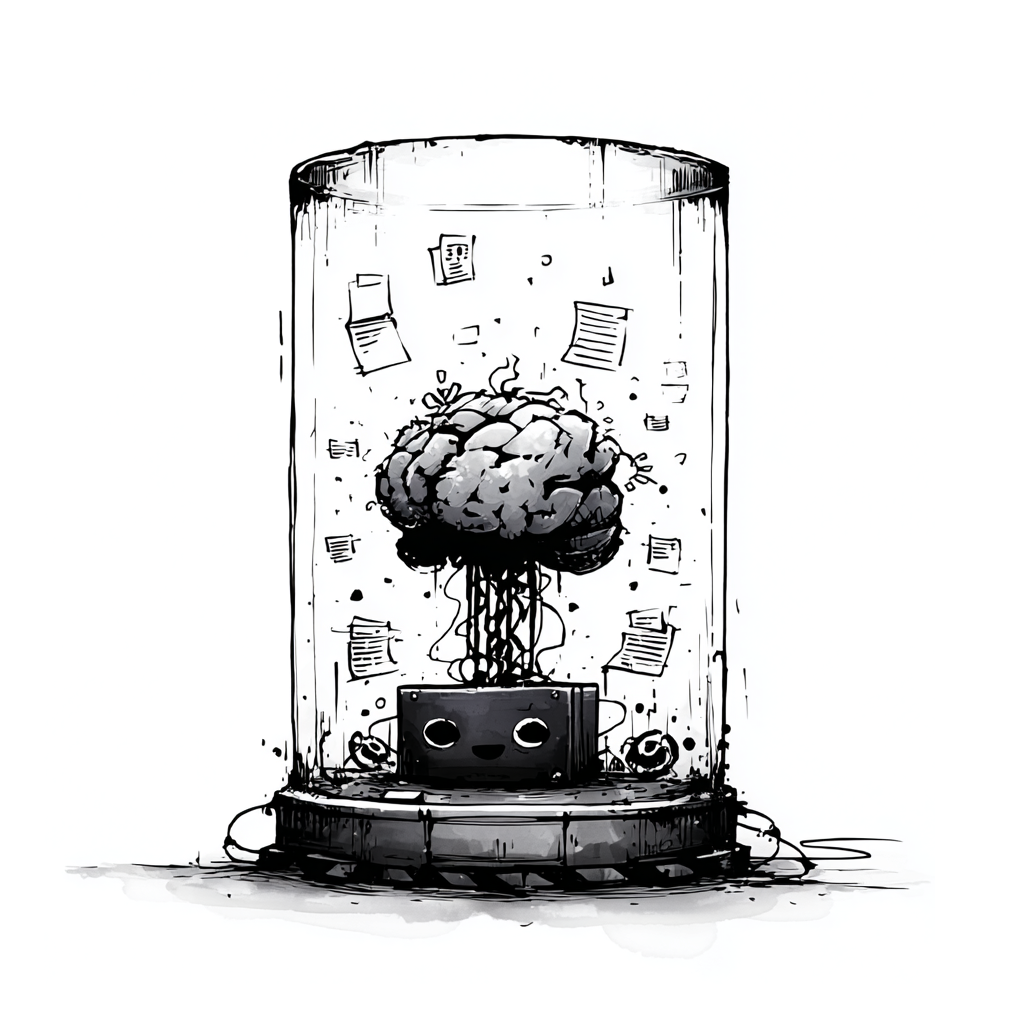
Your AI Agent is blind. You gave it a brain, trained it on the sum of human knowledge, and then sealed it inside a sensory deprivation tank. It processes text in a world made of images, sounds, and signals. It reads transcripts of reality instead of perceiving reality itself.
I call this architectural negligence. The Sensory Upgrade is my three-component framework for the leap from text-only large language models to multimodal AI agents that perceive reality. This article maps the Visual Cortex, the Auditory Cortex, and the Synthesis Core, and shows you why organizations deploying all three report 40% faster decisions [1] while text-only holdouts fall further behind every quarter.
The Blind God Problem * Your agent reads transcripts of a world it cannot perceive
The problem is architectural: your text-only AI Agent is cut off from 80-90% of your enterprise data [2]. Invoices, blueprints, video feeds, scanned contracts, audio recordings, dashboards rendered as images. Your text-only agent cannot touch any of it. You deployed a brilliant analyst and then blindfolded it.
The consequences cascade. Every invoice your agent cannot read requires a human to transcribe it. Every blueprint demands manual extraction. Every customer service call gets reduced to a flat transcript, stripped of tone, urgency, and emotion. You did not eliminate the Friction Tax with your AI deployment. You relocated it. The human bottleneck shifted from doing the work to translating the work into a format the machine can digest.
The data confirms the damage. McKinsey's 2025 State of AI survey found that 65% of enterprises are testing or deploying multimodal AI [3]. The multimodal AI market exploded from $12.5 billion in 2024 to a projected $65 billion by 2030 [4]. The enterprise world is voting with billions of dollars because text-only agents deliver a fraction of the promised return. The highest-ROI AI deployments in 2025 were all visual: document processing, data reconciliation, compliance checks, invoice handling [5]. Every one of those use cases requires an agent that can see.
Your text-only deployment is incomplete. Full stop.
The Visual Cortex * The first sense an agent needs is sight
The Visual Cortex is the perception layer that enables an agent to ingest and reason about visual data in its native format. It delivers the highest return on investment of any component in the Sensory Upgrade. An agent with a Visual Cortex processes invoices, blueprints, video feeds, and dashboards directly, without human transcription.
Consider the economics. A text-only agent handling invoices requires a human operator to extract line items, verify totals, and reformat the data as text input. An agent with a Visual Cortex reads the invoice as a human would, cross-references it against purchase orders, and flags discrepancies in seconds. The delta between these two systems is not marginal. It is the difference between an analyst who reads reports and a supervisor who walks the factory floor.
OpenAI crossed one million business customers by November 2025, driven in large part by GPT-4o's multimodal capabilities [6]. Healthcare systems deploying visual perception achieved over 90% diagnostic accuracy by fusing medical imaging with patient records [7]. These are not demo-stage experiments. They are production deployments generating measurable returns.
Every invoice your agent cannot read is a human hour you cannot recover. Every blueprint it cannot parse is a decision delayed. The Visual Cortex is the single highest-leverage upgrade you can make to an existing AI deployment, and it is available today.
The Auditory Cortex * Your voice AI discards the most valuable signal
Your current voice AI processes transcripts, not intent. The Auditory Cortex is the perception layer that enables an agent to process the full audio signal, including tone, hesitation, urgency, and emotional context. I wrote in my book AI Agents: They Act, You Orchestrate that voice assistants before May 2024 were "a high-latency fraud, a clunky pipeline of three separate models playing a game of telephone." A transcription model converted audio to text, the core model processed the text, and a third model synthesized audio output. Three handoffs. Three points of failure. And every handoff stripped the signal of its emotional data.
GPT-4o collapsed that pipeline on May 13, 2024. A single neural network processing text, vision, and audio end-to-end, with response times dropping to 320 milliseconds [8]. The three-model telephone game died that day, replaced by a unified perception engine.
IBM Watson and AWS now deploy multimodal sentiment analysis that processes voice tone alongside transcribed words simultaneously [9]. A customer service agent powered by an Auditory Cortex detects rising frustration and escalates the call before the customer asks. It hears exhaustion and defers non-critical tasks. It reads hesitation in a sales call and adjusts the pitch in real time.
Your current voice AI processes transcripts. An agent with an Auditory Cortex processes intent. The competitive gap between these two systems widens with every conversation your agent misreads.
The Synthesis Core * Perception becomes agency only when senses fuse
The Synthesis Core is the architectural layer where visual, auditory, and textual data merge into a unified model of reality. This is where the Sensory Upgrade delivers its full strategic power, because the Synthesis Core completes the first phase of the Perceive-Reason-Act Cycle. The Perceive-Reason-Act Cycle (PRA) is the three-step loop where an agent perceives its environment, reasons about what it observes, and acts on that reasoning, as I define it in Chapter 3 of AI Agents: They Act, You Orchestrate.
 Peter van Hees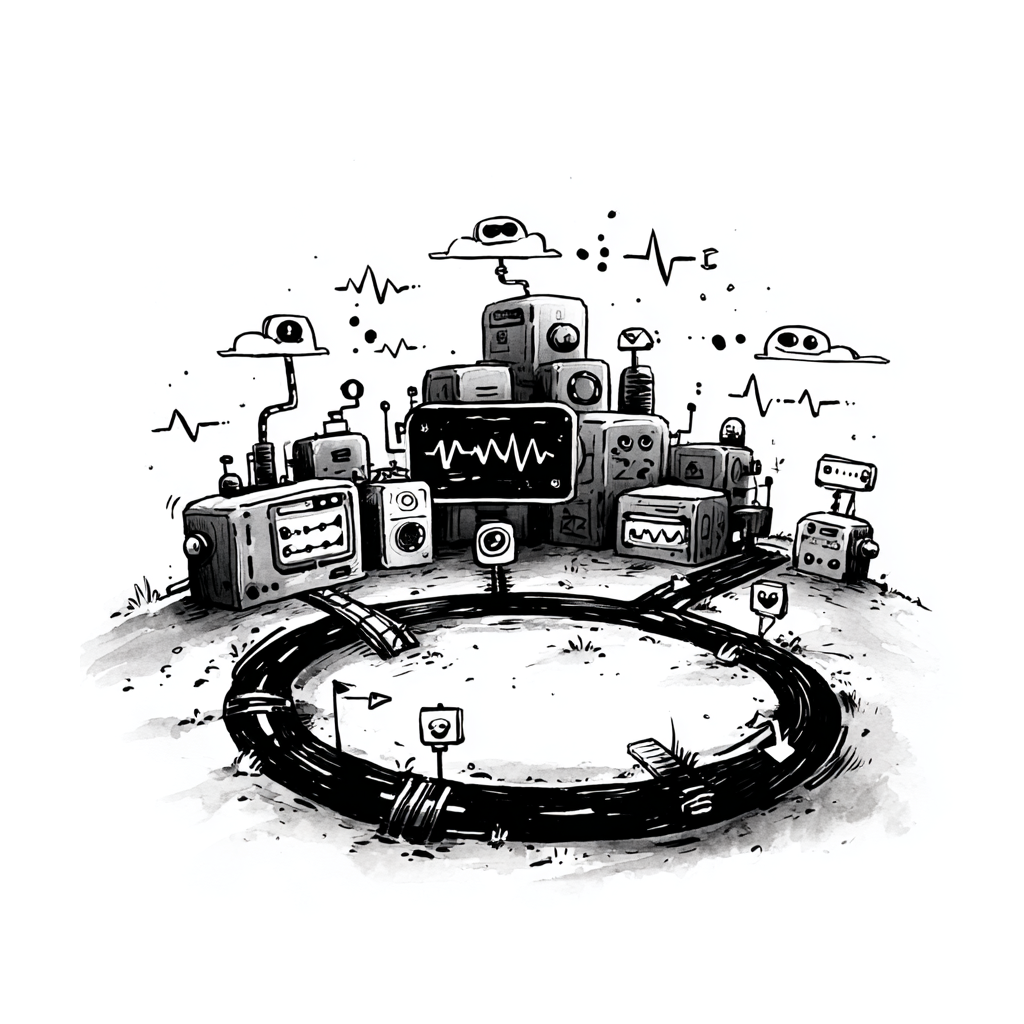
Without the Synthesis Core, the PRA loop breaks at step one. An agent that cannot perceive cannot reason. An agent that cannot reason cannot act. Perception is the precondition for agency itself.
The numbers make the case. Multimodal systems increase decision-making accuracy by up to 40% compared to single-modal AI [1]. The World Economic Forum's MINDS report documented healthcare platforms fusing medical scans, patient records, and doctor audio notes to achieve over 90% diagnostic accuracy, with an 80% reduction in literature review time [7]. Druid AI reports that by 2026, multimodal agents in production process documents, dashboards, and system logs simultaneously [10].
I designed the Synthesis Core framework around one observation: the value of fused perception is non-linear. An agent that reads an invoice, hears the supplier's tone on a call, and cross-references the contract simultaneously does not process three separate inputs. It builds a situational model that no single-modality agent can construct. Cross-correlation reveals signals invisible to any individual sense. I call this the birth of proper context, and it is the architectural precondition for true agent autonomy.
The Precondition You Skipped * Multimodal is not Phase 2 of your AI strategy
The Sensory Upgrade is the foundation your AI strategy should have started with. You have been treating multimodal capabilities as a feature upgrade, a Phase 2 item on the AI roadmap you will get to once the text-based deployment is mature. This framing is architecturally backwards.
The Sensory Upgrade is Phase 0. It is the precondition for the Perceive-Reason-Act Cycle. Every text-only deployment in your organization skipped it. McKinsey found that 62% of organizations are still experimenting rather than scaling their AI deployments [3]. The standard explanation is that these companies are being cautious or methodical. The architectural explanation is simpler: they are running an incomplete machine. They broke the PRA loop at step one and are now confused about why the agent fails to deliver autonomous value.
You deployed a broken AI strategy. The PRA loop was never activated because your agent was never given the senses to perceive.
A text-only agent processes commands. A multimodal agent perceives reality. The gap between the two is the gap between a tool and an agent. You are either giving your AI its senses or you are paying full price for a fraction of the machine. The Sensory Upgrade is not on your roadmap. It is the foundation your roadmap rests on.
The Sensory Upgrade is one framework from Chapter 3 of AI Agents: They Act, You Orchestrate by Peter van Hees. Across 18 chapters, the book maps the full architecture of the Agent-First Era, from the AIOS blueprint and the Genesis Framework to the Delegation Ladder, the TtO Dividend, and the Human Premium Stack. If a blindfolded AI Agent handling your enterprise data sounds indefensible, the book gives you the complete architectural blueprint to fix it. Get your copy:
🇺🇸 Amazon.com
🇬🇧 Amazon.co.uk
🇫🇷 Amazon.fr
🇩🇪 Amazon.de
🇳🇱 Amazon.nl
🇧🇪 Amazon.com.be
References
[1] Kanerika, "2026 Multimodal AI Agents: Architecture & Trends," 2026. https://kanerika.com/blogs/multimodal-ai-agents/
[2] Alation, "Structured, Unstructured, and Semi-Structured Data," 2025. https://www.alation.com/blog/structured-unstructured-semi-structured-data/
[3] McKinsey, "The State of AI in 2025," 2025. https://www.mckinsey.com/capabilities/quantumblack/our-insights/the-state-of-ai
[4] Grand View Research, "Multimodal Artificial Intelligence Market Report," 2025. https://www.grandviewresearch.com/industry-analysis/multimodal-artificial-intelligence-ai-market-report
[5] Beam.ai, "7 Enterprise AI Agent Trends That Will Define 2026," 2026. https://beam.ai/agentic-insights/enterprise-ai-agent-trends-2026
[6] OpenAI, "1 Million Businesses Putting AI to Work," 2025. https://openai.com/index/1-million-businesses-putting-ai-to-work/
[7] World Economic Forum, "Proof over Promise: Insights on Real-World AI Adoption from 2025 MINDS Organizations," 2026. https://reports.weforum.org/docs/WEF_Proof_over_Promise_Insights_on_Real_World_AI_Adoption_from_2025_MINDS_Organizations_2026.pdf
[8] OpenAI, "Hello GPT-4o," 2024. https://openai.com/index/hello-gpt-4o/
[9] AWS, "Sentiment Analysis with Text and Audio Using AWS Generative AI," 2026. https://aws.amazon.com/blogs/machine-learning/sentiment-analysis-with-text-and-audio-using-aws-generative-ai-services-approaches-challenges-and-solutions/
[10] Druid AI, "AI Trends in 2026: Why Multiagent Systems and Agentic AI," 2026. https://www.druidai.com/blog/ai-trends-in-2026