Your AI Agent Cannot See * Perceive-Reason-Act Cycle
Most AI Agents fail because they cannot perceive. The Perceive-Reason-Act Cycle is the diagnostic framework that exposes where your agent architecture breaks. 95% of enterprise AI pilots collapse, and the fix starts with perception, not bigger models.

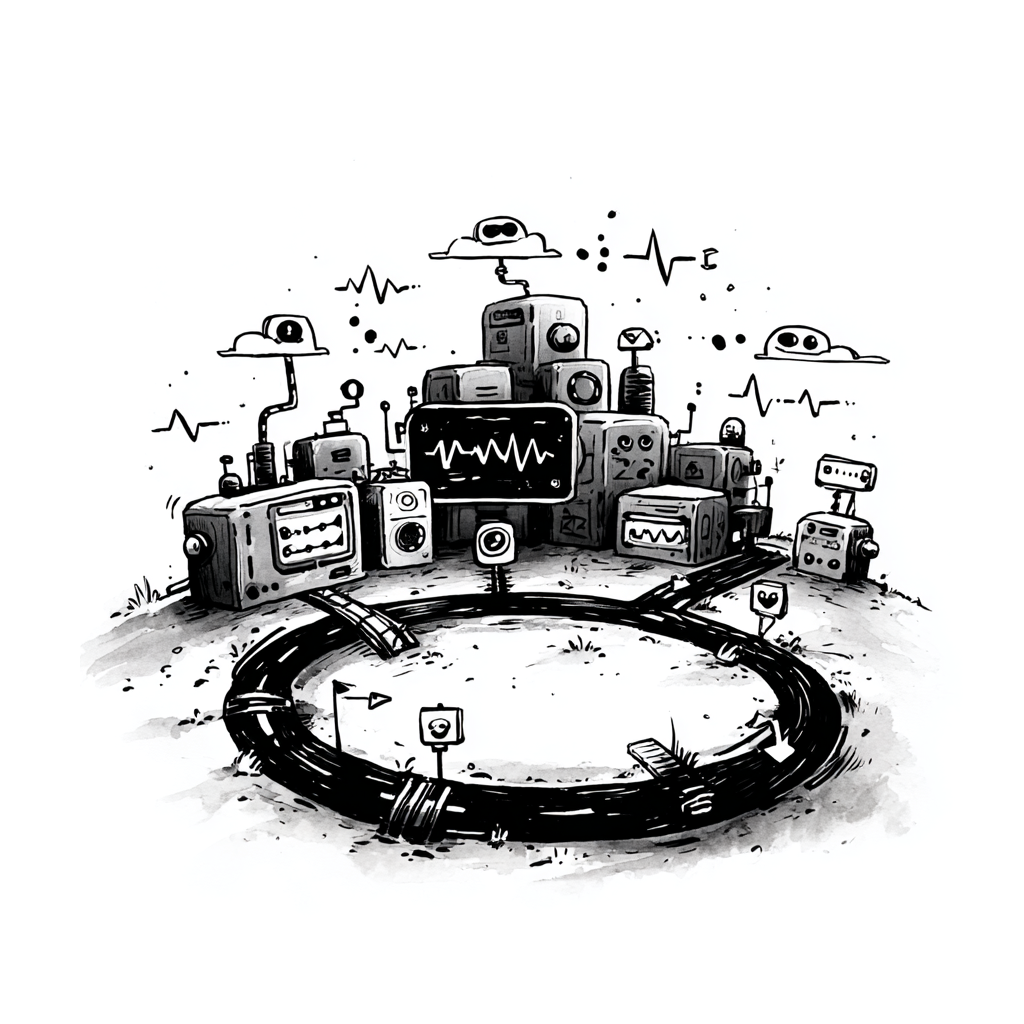
Your AI Agent cannot see. It processes prompts, generates responses, and executes tool calls. But it operates in a state of architectural blindness, cut off from the real-time world state it needs to act with consequence. You have deployed what your vendor calls an "agent." You have received an assistant wearing a stolen uniform.
The Perceive-Reason-Act Cycle is the three-phase loop that defines true agency: an AI Agent must actively perceive live world state, reason about multi-step strategy, and execute actions that produce real consequences that feed back into the next perception. This framework is a diagnostic for exactly the failure you are experiencing. Here is what it reveals: why the Perceive-Reason-Act Cycle exposes the real bottleneck in your agent strategy, how to identify which phase is broken, and what to fix first.
Why Do Most AI Agents Fail?
The market is drowning in counterfeit agents. Products branded as "AI Agents" flood enterprise procurement decks, yet they fail the most basic test of agency: they cannot close the Perceive-Reason-Act Cycle. The three phases expose the counterfeit immediately. They respond to prompts (partial Perceive). They generate answers (partial Reason). They cannot execute multi-step workflows with real-world consequences (no Act). And they never feed outcomes back into perception (no loop). They are assistants with inflated job titles.
The data confirms the fraud. According to the LangChain State of Agent Engineering survey, only 57.3% of organizations have agents in production [1]. Deloitte's 2025 survey is blunter: only 11% of organizations actively use agents, and 35% have no strategy at all [2]. The industry is spending billions on a category it has not yet defined.
The Perceive-Reason-Act Cycle is the definition. The term is not mine alone. Gonzalez et al. in the Journal of Business Research define autonomous AI Agents as "technological entities that perceive, reason, and act upon information sensed from their environments while operating without external control" [3]. Some prefer the military-derived "observe, orient, decide, act" (OODA) Loop or the robotics shorthand "sense-think-act," but OODA presupposes a biological observer making split-second decisions. The PRA Cycle is the correct framing for continuous machine loops: ingest structured world state, synthesize strategy, execute with measurable consequences.
Apply the diagnostic to every "agent" in your stack. Ask three questions. Does it actively perceive live world state without human curation? Does it architect multi-step strategy, or does it retrieve and reformat? Does it execute with real consequences that feed back into the next perception? Any "no" means you have an assistant, not an agent. You have been sold a counterfeit.
Why Is Perception the Bottleneck?
The industry is obsessing over the wrong phase of the Perceive-Reason-Act Cycle.
Every keynote, every funding round, every product launch fixates on reasoning. Bigger models. Longer context windows. Chain-of-thought breakthroughs. Reasoning is the glamorous phase, the one that generates benchmark headlines. But reasoning is the most mature phase of the PRA Cycle and the least likely bottleneck in your deployment.
The overlooked phase is Perceive. Your enterprise data architecture was built for human operators to read dashboards, not for agents to ingest structured world state at machine speed. Deloitte's Tech Trends 2026 report quantifies the damage: 48% of organizations cite data searchability as a challenge, and 47% cite data reusability [2]. Nearly half of all enterprises have built an information architecture that their own agents cannot read.
This is the root cause behind the LangChain survey's most telling finding: quality is the number-one blocker for agent deployment, cited by 32% of respondents [1]. Quality is downstream of perception. If your agent perceives garbage, stale data, unstructured documents, and siloed databases built for human eyeballs, it reasons on garbage. The output looks like a quality problem. The root cause is an architecture problem.
Audit your agent's perception layer with surgical precision. What data sources does it ingest? Are those sources structured for agent consumption or human consumption? How fresh is the data? If your agent reads a daily summary instead of a live data feed, it operates on yesterday's reality. You have built a strategic advisor with a 24-hour delay. And in a market that moves in minutes, yesterday's reality is a liability.
Why Do Enterprise AI Pilots Die at the Act Phase?
The Reason phase is the most celebrated and least dangerous part of the loop. I say "least dangerous" deliberately. A model that reasons brilliantly but cannot act is a thought experiment. Call it what it is: entertainment.
The critical transition is from Reason to Act: the moment the agent's strategy produces real-world consequences. This is where 95% of enterprise AI pilots die [4]. The agent reasons correctly. It identifies the right action. Then it hits a wall. The order system has no API. The pricing engine requires three levels of human approval. The HR platform was built in 2009 and communicates through CSV exports. Legacy systems lack the APIs, permissions, and governance structures that allow an agent to close the loop.
The LangChain survey reveals a telling asymmetry: 89% of organizations have implemented observability for their agents, but only 52% run offline evaluations [1]. Translation: teams watch their agents think but never let them act at scale. They have built elaborate monitoring for a loop that never completes. They observe reasoning without consequence.
Map every system your agent needs to touch during the Act phase. For each one, answer three questions. Does it have a serviceable API? Does the agent have permissions to write, not just read? Is there a governance threshold for autonomous action versus human escalation? Every "no" is a break in the PRA Cycle. Every break is a reason your pilot will join the 95%.
What Do Winning Deployments Share?
The companies winning with agents share one trait: they re-architected their systems around the full Perceive-Reason-Act Cycle. They did not bolt an LLM onto legacy infrastructure and call it innovation.
Salesforce did not attach a language model to its existing CRM. It rebuilt the data layer (Perceive), the reasoning layer (multi-step lead qualification), and the action layer (autonomous prospecting, outreach, and follow-up) as a single closed loop. The result: a 282% increase in AI adoption among Agentforce customers [3]. Salesforce succeeded because it closed the loop. The outcome of each agent action feeds directly into the next perception cycle. The agent compounds.
Coding agents tell the same story from a different angle. Claude Code, Cursor, and GitHub Copilot are the most commonly deployed agents in day-to-day workflows [1]. Why do coding agents succeed where enterprise agents stall? Because the development environment is already structured data. Code repositories, test suites, CI/CD pipelines: these are perception-ready architectures. The agent perceives the codebase, reasons about the change, acts by writing code, and perceives the test results. The loop closes in seconds. No human needs to reformat a dashboard or export a CSV.
The common denominator is loop integrity, not model sophistication.
Evaluate your agents by the integrity of their loop, not by their reasoning capability. The only question that matters: how fast does the outcome of one action become the input of the next perception? The tighter the loop, the more the agent compounds in value. The looser the loop, the faster it decays into a chatbot with a marketing budget.
Where Does the Real Failure Live?
The Perceive-Reason-Act Cycle describes agency itself, biological or synthetic. Strip away the vendor marketing, and this loop is all that remains.
Every professional who succeeds runs the same loop. You perceive the market. You reason about strategy. You act with consequence. And you feed the result back into your next perception. I did not invent this loop. The Perceive-Reason-Act Cycle strips away the marketing language and forces you to see the architecture underneath.
If your agent cannot close the Perceive-Reason-Act Cycle, you, the Orchestrator, own the failure. You have not architected the environment for the loop to run. Your data is siloed. Your APIs are missing. Your governance is designed for humans, not for machines that act at machine speed. The failure is architectural, and it has been hiding behind the AI label long enough.
The Perceive-Reason-Act Cycle is a diagnostic, not a feature request. Run it on every agent in your stack today. For each one, identify exactly where the loop breaks. That break point is your single highest-priority investment. The organizations that close the loop first will compound their advantage at a rate their competitors cannot match. The window for architectural readiness is measured in quarters, not years. Close the loop, or watch someone else close it for you.
The Perceive-Reason-Act Cycle is one framework from AI Agents: They Act, You Orchestrate by Peter van Hees. Across 18 chapters, the book builds the full architecture of the Agent-First Era: the Autonomy Spectrum that separates real agents from counterfeits, the Delegation Ladder that calibrates how much autonomy each loop iteration earns, and the failure modes that break the cycle under production pressure. If the gap between your "agents" and true agency resonated, the book gives you the complete engineering blueprint. Get your copy:
🇺🇸 Amazon.com
🇬🇧 Amazon.co.uk
🇫🇷 Amazon.fr
🇩🇪 Amazon.de
🇳🇱 Amazon.nl
🇧🇪 Amazon.com.be
References
[1] LangChain, "State of Agent Engineering Report," December 2025. https://www.langchain.com/state-of-agent-engineering
[2] Deloitte, "Tech Trends 2026," as reported by ZDNet, "Why AI agents failed to take over in 2025." https://www.zdnet.com/article/why-ai-agents-failed-to-take-over-in-2025-story-as-old-as-time-deloitte/
[3] Gonzalez, G.R., Habel, J., & Hunter, G.K., "AI agents, agentic AI, and the future of sales," Journal of Business Research, Volume 202, January 2026. https://www.sciencedirect.com/science/article/abs/pii/S0148296325006228
[4] Forbes (Yildiz, G.), "AI Productivity's $4 Trillion Question: Hype, Hope, And Hard Data," January 20, 2026. https://www.forbes.com/sites/guneyyildiz/2026/01/20/ai-productivitys-4-trillion-question-hype-hope-and-hard-data/