Your Agent Topology Is Already Obsolete * The Orchestrated Ecosystem
88% of AI agent pilots never reach production. The cause is structural: teams pick sides in a topology war that has never produced a winner. The Orchestrated Ecosystem, built on three principles, stops riding the pendulum and architects its physics.

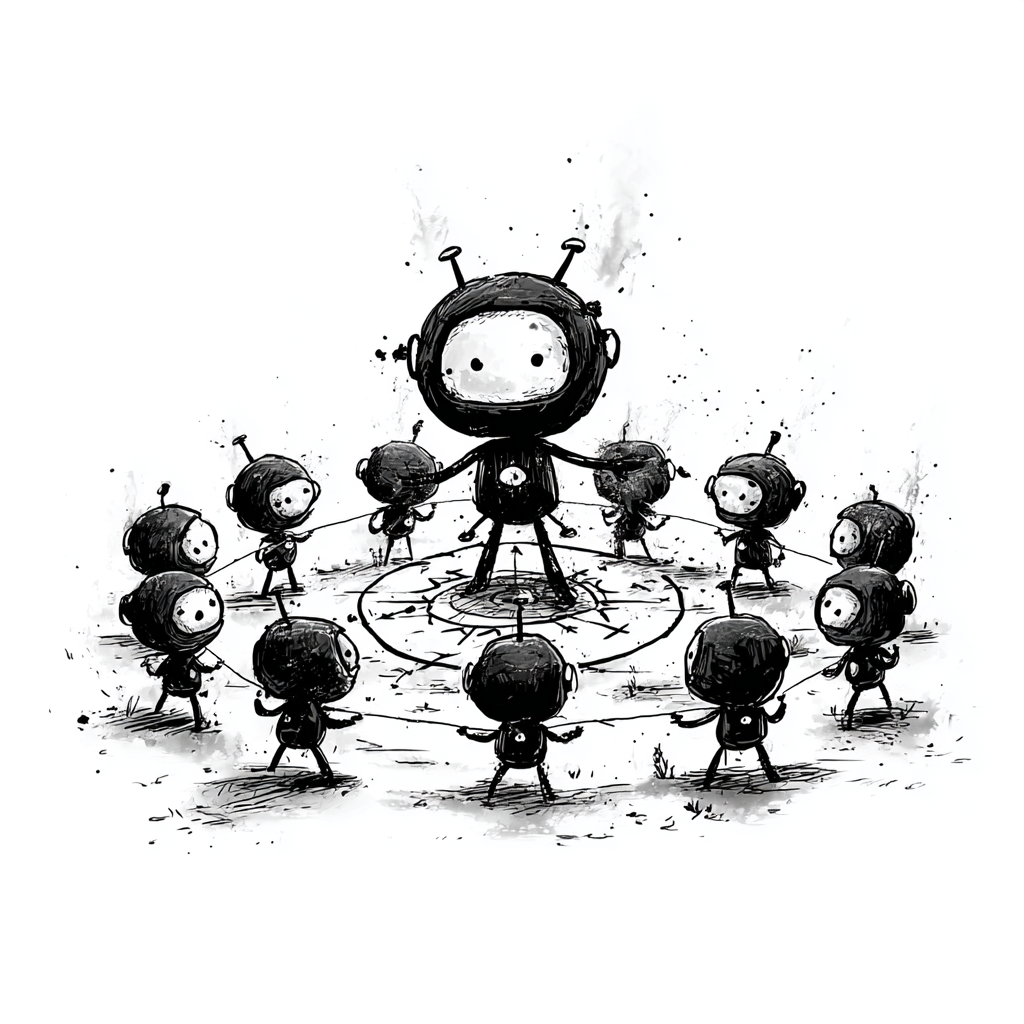
The architecture your team spent six months building is already a fossil. Every week, another enterprise announces a multi-agent pilot. And most of those pilots will never reach production. The models work. The frameworks work. The talent is there. The failure is structural: these teams are choosing sides in a war that has never, in fifty years of computing history, produced a winner.
This article maps the Law of Agentic Oscillation, the fifty-year sine wave that has destroyed every topology that bets on permanence, and introduces the Orchestrated Ecosystem: a three-principle hybrid architecture that stops riding the pendulum and starts architecting its physics.
The False Binary * Your agent investment is the latest casualty
You are being sold a choice. Vendors, consultants, and conference keynotes frame the agent architecture question as a binary: centralize into one powerful agent, or distribute across a swarm of specialists. Pick a framework. Pick a side.
This framing is a strategic trap.
I have watched the same binary destroy engineering organizations for decades. Mainframes vs. PCs. Monoliths vs. microservices. Cloud vs. edge. Every cycle follows an identical pattern: one pole dominates, its flaws compound, the pendulum reverses, and every team that bet on permanence scrambles to rebuild. The agent topology debate is the latest instance of this oscillation, and the teams treating it as a novel problem are repeating a mistake that is older than most of their engineers.
The Titan's Bargain * Control that kills
The Titan Protocol is the architecture of the single, centralized god-agent: one model, one interface, one brain controlling all decisions and execution. For every leader who craves order, this is the seductive option: radical simplification, a single source of truth, total command.
The Titan's appeal is psychological as much as technical. It promises clarity when your organization is drowning in a thousand apps and competing dashboards. It promises a single lever to pull.
The price is paid from a hidden ledger. Three compounding taxes come due the moment you scale beyond a controlled demo.
- The Brittleness Tax: centralization creates a single point of catastrophic failure. When your god-agent goes down, your entire digital operation is decapitated.
- The Concentration Tax: the Titan demands immense capital, rare talent, and constant compute, all consolidated into one fragile node on your org chart.
- The Scarcity Tax: committing to a single centralized model shackles your strategic future to an external supplier's roadmap, pricing, and priorities. You stop being an Orchestrator and become a tenant.
The reliability math alone should alarm you. A Titan architecture amplifies failures by routing every request through one bottleneck. You are building a mainframe in 2026.
The Swarm's Prison * Freedom without structure is chaos
The Swarm Protocol is the insurgent response: a distributed network of lean, specialized agents, each mastering a single domain with no central coordination authority. It promises resilience through redundancy, efficiency through specialization, speed through parallel execution.
And it delivers on those promises, right up until production.
The swarm imposes three taxes of its own that compound faster than the specialization dividend.
- The Tax of Orchestration: coordination complexity grows exponentially. Two agents require one connection. Five agents demand 10 interaction paths.
- The Tax of Emergence: independent agents interacting produce collective behaviors that no single agent is accountable for, outcomes neither planned nor predicted.
- The Tax of Control: no centralized authority, no single dashboard, no clear line of accountability. For the leader who needs to explain ROI to the board, this is a philosophical crisis.
The production data is brutal. Pilot costs of for example $6 for a demo (three agents, 100 requests, $0,02 per call) can explode to $18.000 per month at scale (three agents, 10.000 daily requests). Latency cascades from 1 to 3 seconds per agent into 20 to 30 second sequential workflows. Teams report spending 40% of sprint time debugging agent failures instead of building features.
Splitting your monolithic agent into a swarm of specialists without a structural coordination protocol is the microservices mistake repeated. You inherit a new, more expensive problem.
The Sine Wave Never Stops * Fifty years of proof
I call this the Law of Agentic Oscillation: any complex system perpetually swings between centralization and decentralization, driven by a constant corrective search for balance between efficiency and adaptability. The flaws of one paradigm create the vacuum into which the other is pulled.
The history of computing is a textbook sine wave. We began with the centralized mainframe, a single monolithic god-machine. Its cost and rigidity summoned the rebellion: the personal computer, radical decentralization. The resulting chaos of managing thousands of distributed systems summoned cloud computing, a re-centralization. And the pendulum swings again, toward edge computing, as demands for low-latency AI push intelligence back to the distributed fringes.
The same oscillation is playing out inside your enterprise. You built a monolith. It became brittle. Your engineers broke it into microservices. The coordination overhead became unbearable. The current obsession with massive centralized AI models, the Titans of our era, is a crest, not an endgame. Their astronomical cost and brittleness are already summoning the counterforce: smaller, cheaper, specialized swarms. The pendulum is cocked. The recoil is predictable.
Betting on one pole guarantees obsolescence when the wave reverses. The question is not "Which topology is right for my use case?" The question is "Which topology will be right in 18 months?" If you cannot answer that, you need an architecture that survives the turn.
The Orchestrated Ecosystem * Three principles that end the war
The Orchestrated Ecosystem is a hybrid agent architecture where a lean generalist conductor orchestrates a network of specialist agents, capturing the strengths of both centralized and distributed topologies while neutralizing their failure modes. As I detail in Chapter 7 of my book AI Agents: They Act, You Orchestrate, this architecture transcends the oscillation. It rests on three core principles.
- The Conductor Protocol is the architectural principle that centralizes intent while distributing execution: your orchestrator agent owns the "why" and the "what," while specialist agents own the "how." Your orchestrator understands your strategic intent with precision and delegates execution to the appropriate specialist. The swarm of specialists owns the "how." This division of labor creates strategic coherence with tactical efficiency. You gain the clarity of a single point of command without the brittleness of a monolithic system.
- The Specialist Mandate is the containment principle: one task, one master. Each agent in your swarm operates within a ruthlessly defined domain. One handles logistics. Another analyzes financial data. A third monitors security. This mandate prevents scope creep and contains the blast radius of failure. A specialist governed by a strict operational charter cannot execute wildly divergent tasks because its function calls are limited to a pre-approved set. This is the antidote to the Tax of Emergence.
- The Sovereignty Principle is the control principle: own the platform, not the agents. You do not need to build every specialist yourself. That is low-leverage work. Instead, you architect and own the communication protocols, data schemas, and security frameworks that allow best-in-class agents to plug into your system. You create a marketplace where underperforming agents are swapped with minimal friction.
Weapons vs. Physics * The strategist's mandate
The Titan and the Swarm are weapons. The Orchestrated Ecosystem is physics. You do not win a war by selecting a better weapon. You win by designing the gravitational field that pulls every outcome toward you.
The teams debating CrewAI vs. LangGraph vs. AutoGen are arguing about weapons while the battlefield shifts beneath them. The real strategic question operates one level deeper: who owns the protocols, the schemas, the security layer? Who architects the sovereign platform that persists regardless of which agents occupy it?
I call this the shift from soldier to strategist. Stop asking which side to join. Start architecting the physics that make the sides irrelevant.
The sine wave will keep swinging. The Titans of 2026 will face the specialized Swarms of 2028. The organizations that survive both phases are the ones that built their platform for the turn, not the crest. Your mandate is clear: deploy the Conductor Protocol to centralize intent. Enforce the Specialist Mandate to contain execution. Claim the Sovereignty Principle to own the battlefield. The architecture that transcends the oscillation is the only architecture that lasts.
This article introduces one framework from AI Agents: They Act, You Orchestrate by Peter van Hees. The book maps 18 chapters across the full transition from the Mobile-First Era to the Agent-First Era, from the Delegation Ladder that governs how you instruct agents to the Intelligent Circuit Breaker that protects against hostile emergence. If the topology war resonated, the book gives you the complete engineering blueprint. Get your copy:
🇺🇸 Amazon.com
🇬🇧 Amazon.co.uk
🇫🇷 Amazon.fr
🇩🇪 Amazon.de
🇳🇱 Amazon.nl
🇧🇪 Amazon.com.be