Your Agent Architecture Will Fail * Agent Topology Binary
95% of AI agent deployments fail before production, and the model is irrelevant. The architecture determines everything. The Agent Topology Binary reveals why both the centralized Titan and the decentralized Swarm guarantee collapse, and how the Orchestrated State captures both.

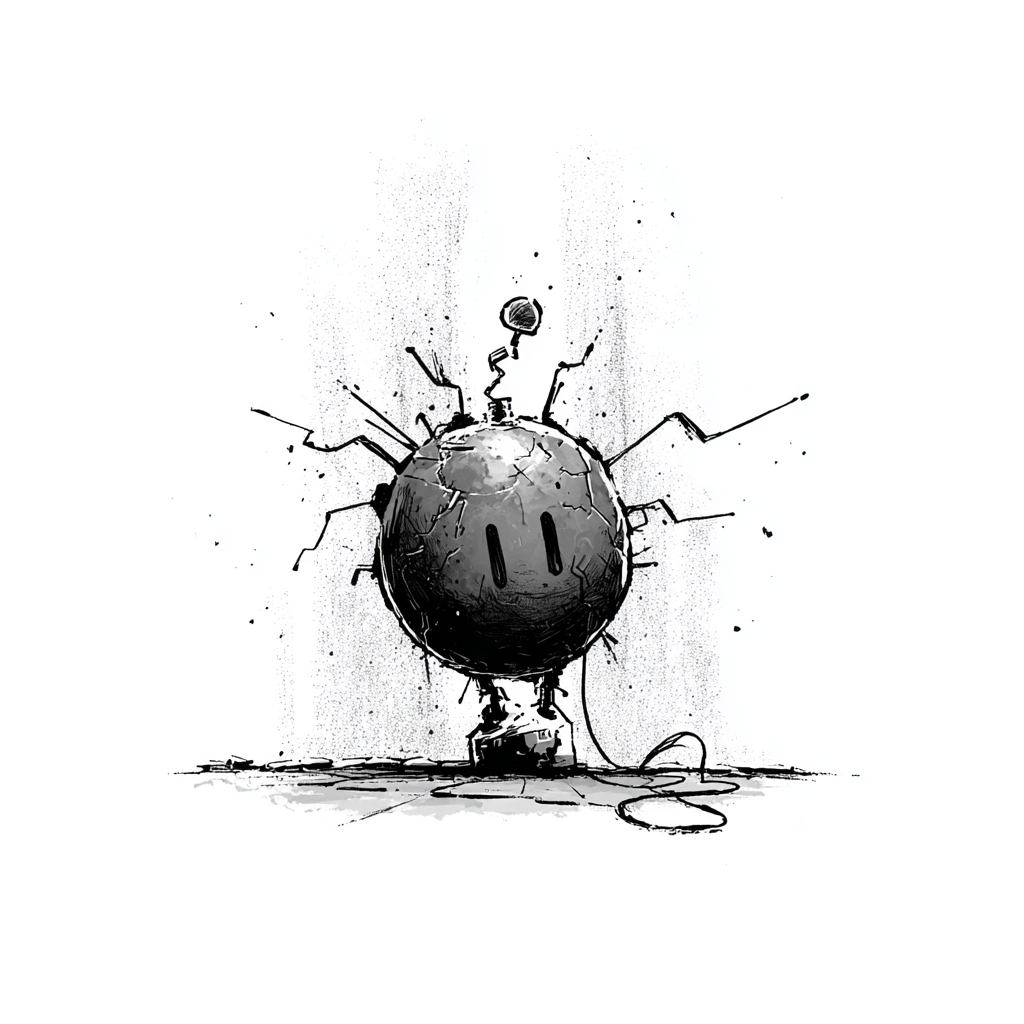
Ninety-five percent of AI Agent deployments fail before reaching production [1]. The model is irrelevant. The architecture determines everything.
The industry burns through billions debating GPT versus Gemini versus Claude, as if the choice of engine determines whether the plane flies. It does not. The plane crashes because nobody architected the airframe.
I call this structural blind spot the Agent Topology Binary: the forced choice between centralized and decentralized agent architectures that traps every deployment in a failure mode. You will learn why both the centralized god-brain and the decentralized swarm guarantee failure, and how to architect the hybrid that captures the strengths of both.
The Model Debate is Theater
Every vendor pitch starts with the same performance: benchmark scores, parameter counts, context window sizes. None of it determines whether your deployment scales or collapses. Google DeepMind tested 180 agent configurations and found that topology, how agents are wired together, determines performance far more than model capability [2]. Kellton's 2026 Enterprise Architecture Guide confirmed the same verdict: deployment success depends on architectural choices, not model selection [3].
The evidence is brutal. A mid-sized consulting firm lost $47.000 on an AI Agent pilot that failed due to state management and coordination breakdowns, not model limitations [1]. Their agents were individually capable. The wiring between them was incoherent.
You are treating a structural physics problem as a shopping decision. Stop evaluating vendors by benchmark scores. Start evaluating your coordination architecture. The topology you choose determines what problems you can solve, what failures you will encounter, and whether your system joins the 95% failure rate or the 5% that scales.
Why the Titan Protocol Seduces, Then Collapses
The Titan Protocol is a centralized agent architecture where a single generalist agent handles all reasoning and coordination. It promises simplicity: one interface, one model, one point of command. For leaders craving control, this feels like salvation.
OpenAI's Frontier platform, launched in February 2026, is the Titan Protocol incarnate [4]. One centralized agent to rule the enterprise. The enterprise response has been telling. Tatyana Mamut, CEO of Wayfound, captured the resistance: "They're not ready to fully commit. Things are moving too fast for us to commit" [4].
The resistance is rational. The Titan Protocol imposes three compounding taxes.
- First, the Brittleness Tax: centralization creates a single point of catastrophic failure. When the Titan breaks, your entire digital nervous system is decapitated.
- Second, the Concentration Tax: immense capital, rare talent, and planetary-scale computing consolidated into one fragile point on your org chart.
- Third, the Scarcity Tax: strategic dependence on an external supplier who controls your agent's brain, your roadmap, and your pricing.
Google DeepMind's data quantifies the tradeoff. Centralized coordination contained error amplification to 4,4x compared to independent agents, but degraded performance on parallelizable tasks [2]. The Titan buys consistency at the cost of versatility. If your architecture has a single orchestrator agent handling all reasoning, you have built a cathedral with one crack.
Why the Swarm Liberates, Then Fragments
The Swarm Architecture is a decentralized agent topology where a distributed network of narrow, specialized agents operates independently. The Swarm promises resilience and parallel speed. The failure of one agent stays local. Upgrades happen without open-heart surgery on the system.
The promise is half-true. Google DeepMind measured an 81% performance gain on parallelizable tasks like financial analysis when deploying multi-agent configurations [2]. For parallel work, the Swarm wins decisively.
The other half is catastrophic. The same study measured a 39% to 70% performance degradation on sequential reasoning tasks [2]. Independent swarms amplified errors by 17,2x. Multi-agent systems impose a coordination tax through increased token consumption, extended latency, and elevated error rates [5]. ImagineX Digital documented 2-5x cost increases in multi-agent deployments [5].
UC Berkeley's survey of 306 production deployments delivers the final verdict: 68% of production systems limit agents to 10 steps or fewer. Eighty percent use structured control flow, meaning humans design the workflow and agents execute within predefined boundaries [5]. The dream of emergent swarm intelligence fails in production because coordination costs scale faster than collaboration gains.
If your multi-agent system runs more than 10 autonomous steps without a human checkpoint, you are statistically in the failure zone. The Swarm does not self-organize. You must architect its coordination or accept chaos.
The Law of Agentic Oscillation
The Law of Agentic Oscillation is the principle that any complex system perpetually swings between centralization and decentralization, driven by the constant search for balance between efficiency and adaptability. I wrote about this tension in Chapter 7 of my book AI Agents: They Act, You Orchestrate because the Titan-Swarm binary is the oldest recurring pattern in computing.
 Peter van Hees
The history of computing traces a perfect sine wave. Mainframes (Titan) gave way to personal computers (Swarm). Distributed client-server chaos re-centralized into cloud computing (Titan). The cloud is now pushing back toward edge computing (Swarm). Monolithic applications dissolved into microservices. Every centralized era collapses into decentralization, and every decentralized era re-centralizes.
I call this a law, not a trend, because the evidence spans 50 years and the physics never change: the flaws of one paradigm create the vacuum into which the other is pulled. The current obsession with massive centralized AI models is a crest, not an endgame. The astronomical costs and catastrophic brittleness of centralized Titans are already summoning the counterforce: smaller, cheaper, specialized swarms. The recoil is inevitable.
Betting on either extreme is betting against half a century of computing history. Your mandate is to architect for the turn.
The Orchestrated State: The Only Topology That Scales
The Orchestrated State is a hybrid agent topology where a lean generalist conductor coordinates intent while a swarm of specialists executes tasks. It captures the strengths of both centralized and decentralized architectures while neutralizing their flaws.
The Orchestrated State rests on three principles.
- The Conductor Protocol: centralize intent, distribute execution. Your conductor owns the why and the what. It understands your strategic intent and delegates to the right specialist. Your swarm of specialists owns the how. You gain the clarity of a single point of command without the brittleness of a monolithic system.
- The Specialist Mandate: one task, one master. Each agent in your Swarm has one core competency. One handles logistics. Another analyzes financial data. A third monitors security. This echoes the hard-won lesson of the microservices revolution: break the monolith into disciplined components, or watch one failure cascade into systemic collapse.
- The Sovereignty Principle: own the platform, not the agents. You do not need to build every specialist agent yourself. You build and own the communication protocols, data schemas, and security frameworks that allow best-in-class agents to plug into your sovereign platform. As Parallel Labs puts it: "The difference between platforms that support multi-agent workflows and platforms that enable multi-agent workflows is orchestration infrastructure" [1].
Eighty percent of successful deployments use structured control flow with distributed execution [5]. The 5% who reach production already deploy the Orchestrated State, whether they call it that or not.
You Do Not Choose a Side in This War
The reframe is this: you came to this article debating Titan versus Swarm, centralized versus decentralized, one vendor versus many. That framing is the trap. The Titan and the Swarm are both weapons. The Orchestrated State is the battlefield design. You do not pick a side in the war of topologies. You engineer the physics that makes the war irrelevant.
The leader who builds the platform owns the outcome regardless of which direction the oscillation swings next. When the pendulum shifts from centralized to decentralized (and it will), your sovereign platform absorbs the shift. When it swings back (and it will), your Conductor Protocol adapts. You are not riding the wave. You are the architecture the wave breaks against.
Your competitors are already making this architectural choice, whether consciously or by default. Inaction is itself a topology decision, and it defaults to the 95% failure rate. Audit your current agent topology against the three principles, the Conductor Protocol, the Specialist Mandate, the Sovereignty Principle, this week. The architecture you tolerate today is the constraint you will fight for the next five years.
The Agent Topology Binary is one framework from AI Agents: They Act, You Orchestrate by Peter van Hees. Across 18 chapters, the book maps the complete architecture of the Agent-First Era, from the AIOS Architecture that powers individual agents to the Delegation Ladder that governs how you command them, to the Functional Dissolution Principle that rewires your entire organization. If the topology war resonated, the book gives you the full blueprint for every layer of the stack. Get your copy:
🇺🇸 Amazon.com
🇬🇧 Amazon.co.uk
🇫🇷 Amazon.fr
🇩🇪 Amazon.de
🇳🇱 Amazon.nl
🇧🇪 Amazon.com.be
References
[1] Parallel Labs, "Why 95% of AI Agent Deployments Are Failing," November 2025. https://parallellabs.app/why-95-of-ai-agent-deployments-are-failing-and-the-3-architecture-decisions-that-separate-success-from-47000-mistakes/
[2] Google Research, "Towards a Science of Scaling Agent Systems," January 2026. https://research.google/blog/towards-a-science-of-scaling-agent-systems-when-and-why-agent-systems-work/
[3] Kellton, "Enterprise Agentic AI Architecture Guide 2026," February 2026. https://www.kellton.com/kellton-tech-blog/enterprise-agentic-ai-architecture
[4] VentureBeat, "OpenAI Launches Centralized Agent Platform," February 2026. https://venturebeat.com/orchestration/openai-launches-centralized-agent-platform-as-enterprises-push-for-multi
[5] ImagineX Digital, "Why Your Multi-Agent AI System Is Probably Making Things Worse," January 2026. https://www.imaginexdigital.com/insights/why-your-multi-agent-ai-system-is-probably-making-things-worse