The T-Shaped Professional Is Dead * Execution Is the New Commodity
The T-shaped professional model is dead. AI commodified the vertical bar of deep execution in months. The Inverted T-Shaped Professional flips the model: deep judgment on top, broad AI-augmented execution below. Your training budget is manufacturing the wrong shape of worker.

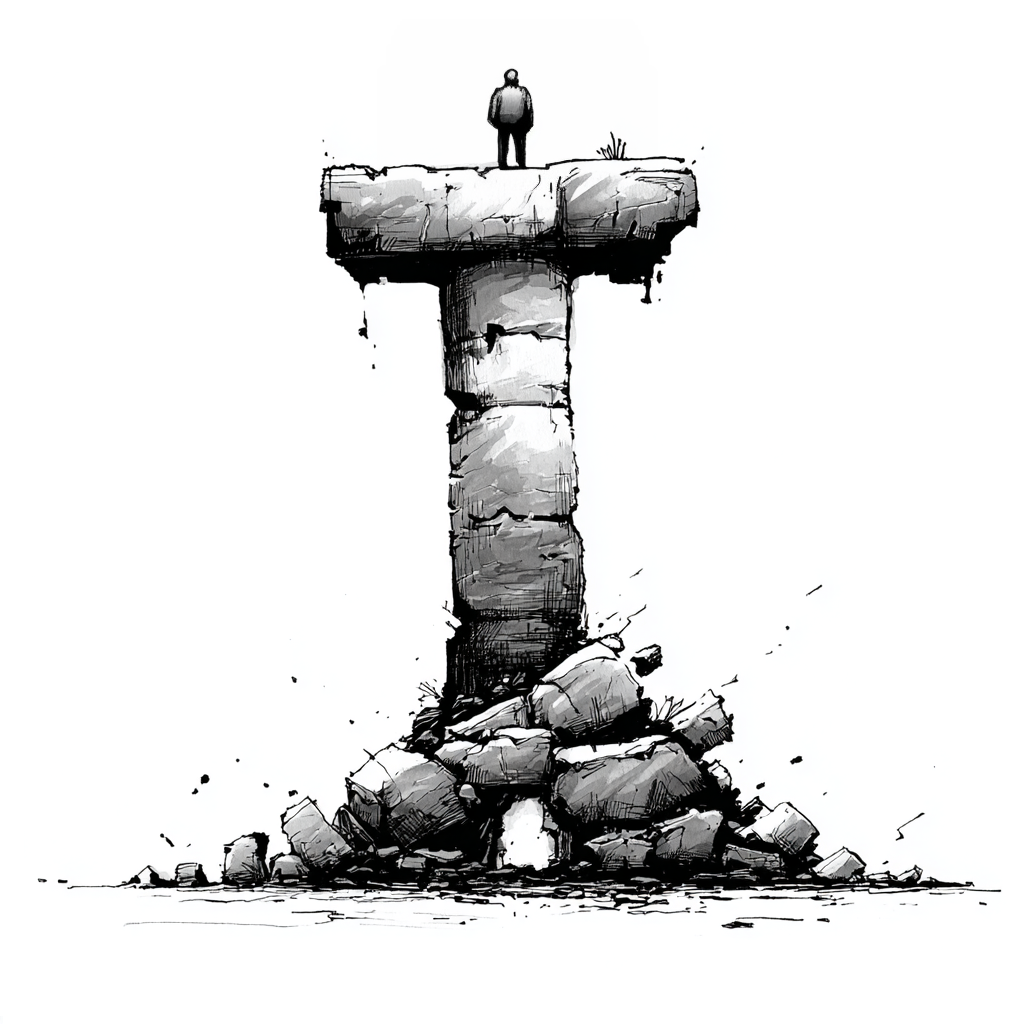
The T-shaped professional, the dominant talent model for three decades, is dead. AI did not kill it by replacing workers. AI killed it by commodifying the skill that made the vertical bar valuable: deep execution. The model that David Guest coined in 1991 and Tim Brown popularized at IDEO assumed that building deep execution expertise required years of deliberate practice and remained scarce. That assumption collapsed the moment a large language model achieved 80% proficiency in most execution domains overnight.
I call its replacement the Inverted T-Shaped Professional. In this article, you will see why the AI job skills that survive require the vertical bar to flip from execution to judgment, why every multi-shaped alternative (Pi, M, Comb) is a dead end that AI resolves automatically, and why the quiet disappearance of entry-level roles is destroying the ladder before the next generation can climb it.
The Vertical Bar Has Been Commodified
For 30 years, the T-shaped model worked because deep execution expertise was expensive, scarce, and slow to acquire. A software engineer spent a decade mastering a language. A financial analyst spent years learning to build models. A copywriter refined voice over thousands of drafts. That vertical bar of specialist execution was the career foundation, the load-bearing wall of professional value.
AI demolished that wall. McKinsey projects 3,7 million office support jobs and 2 million customer service jobs will vanish in the US by 2030 [1]. A mid-level software engineer at a major tech company put it plainly: "AI can straight up write better, faster, more legible code than most developers. But any seasoned engineer knows the hard part isn't writing the code, it's the design and testing" [2].
That quote is the T-shaped obituary compressed into two sentences. The execution half, writing the code, has been commodified. The judgment half, the design and testing, is where value now concentrates. Yet a Harvard Business Review survey of 1.006 global executives found that 60% of organizations have already made headcount reductions in anticipation of AI, not from actual productivity gains [3]. Only 2% made large reductions based on proven AI output. The market is betting on commodification before it has fully arrived. Expectation alone is pricing out your vertical bar. Your value shifts from execution to orchestration.
The Inverted T-Shaped Professional
The Inverted T-Shaped Professional is a talent model where the vertical bar points upward to represent deep judgment and strategic direction, while the horizontal bar at the bottom represents broad AI-augmented execution across many domains. The old T placed deep execution at the bottom, pointing downward, with a thin horizontal bar of general knowledge across the top. The new model flips this structure entirely.
"You were hired for what you could DO."
"You will be valued for what you can OVERSEE, INTEGRATE, and VALIDATE."
This maps directly to two frameworks I developed in my book AI Agents: They Act, You Orchestrate. The Human Premium Stack is the three-tier framework defining durable human value: High-Context Negotiation (reading the room when data runs out), Moral Arbitration (making ethical calls when rules collide), and Zero-to-One Innovation (creating what no model has seen). The new vertical bar of deep judgment corresponds to this stack. The horizontal bar, broad AI-augmented execution, is governed by the Delegation Ladder, a four-stage maturity model (Describe, Specify, Validate, Autonomize) that transforms you from someone who talks to agents into an Orchestrator who engineers outcomes.
The World Economic Forum's Future of Jobs Report 2025 validates this inversion. The top skills gaining currency are analytical thinking, creative thinking, leadership, empathy, and resilience [4]. Every one of these sits on the judgment axis, not the execution axis. Meanwhile, an Asana study found that 77% of workers deploying AI agents call them unreliable, and employees spend an extra 4.5 hours per week fixing agent errors [2]. Broad execution without deep validation is a factory for expensive mistakes.
Pi, M, and Comb Shapes Are Dead Ends
The response to T-shape obsolescence has produced a zoo of alternative models. Pi-shaped professionals cultivate two deep specialties. M-shaped professionals maintain three or more. Comb-shaped professionals develop many shallow ones [5]. These models share a fatal assumption: that human effort is the only path to multi-domain competence.
Developing two deep execution specialties takes decades. Three takes a career. The Pi-shaped professional is a unicorn. The M-shaped professional is a fantasy. The Comb-shaped professional is the right answer built on the wrong foundation.
The Inverted T makes all of them irrelevant. One deep vertical of judgment, augmented by AI execution across dozens of domains, produces a comb-shaped output profile automatically. A marketing director who masters brand strategy (the judgment vertical) can now deploy agents for copywriting, data analysis, visual design, A/B testing, and competitive research (the execution horizontal) without spending years mastering each discipline. The comb profile is no longer a career aspiration. It is a free byproduct of competent orchestration.
Stop chasing multiple deep specialties. Master one domain of judgment. AI handles the execution breadth. I did not write AI Agents: They Act, You Orchestrate to help you become a better tool operator. I wrote it to help you become the Orchestrator who directs the entire system.
The Ladder Has Been Kicked Away
Here is the evidence that should keep every L&D director awake at night. Entry-level job postings in the US have dropped 35% since 2023 [2]. A survey by IDC reports that 66% of enterprises are reducing entry-level hiring because of AI [6]. This erosion is quiet. No mass layoffs. No headlines. Hiring freezes and natural attrition are doing the work in silence.
This creates a structural crisis that the Inverted T exposes but cannot solve alone. Entry-level roles were the training ground for the old T-shaped vertical bar. You built deep execution expertise by doing the work for years. Junior developers wrote code. Junior analysts built models. Junior copywriters produced drafts. Those years of practice forged the judgment that senior professionals now deploy.
Remove the entry-level rung and you destroy the mechanism that produces judgment in the first place. Fast Company reports that senior engineers are burning out handling tasks once done by juniors, with no time to mentor the next cohort [2]. The system is cannibalizing its own foundation.
Universities and corporate training programs are compounding the problem. They are teaching tool usage: how to prompt ChatGPT, how to operate Copilot, how to generate images with Midjourney. This trains the horizontal bar of execution. It does nothing for the vertical bar of judgment. The curriculum for a post-knowledge world must shift from teaching what (execution) to teaching how to architect questions and validate outputs (judgment). I argue in my book that education is building T-shaped graduates for an Inverted T economy, a structural mismatch that compounds with every graduating class.
The Model and the Indictment
The Inverted T doubles as a diagnostic tool. Apply it to the talent pipeline and the fractures become visible: every institution, from universities to corporate L&D to hiring managers, is still manufacturing the wrong shape of professional at industrial scale, while silently removing the entry-level proving ground that made even the old shape possible.
AI replacing workers is the wrong diagnosis. The real failure is systemic. The entire pipeline is optimized for a model that no longer holds.
You need to audit your own professional shape. Today. If your value rests on what you can execute, you are the vertical bar being commodified. If your training budget teaches people to use AI tools without teaching them to validate AI outputs, you are subsidizing your own obsolescence. The Inverted T-Shaped Professional demands you flip: stop deepening execution and start deepening judgment. The professionals who survive the Agent-First Era will be those who invert before the market inverts them.
This article introduces one framework, but the full architecture runs far deeper. AI Agents: They Act, You Orchestrate by Peter van Hees maps 18 chapters across the entire Agent-First Era, from the Human Premium Stack that defines durable human value to the Delegation Ladder that teaches you to orchestrate AI execution with precision. If the commodification of your vertical bar resonated, the book gives you the complete operating manual for becoming an Inverted T-Shaped Professional. Get your copy:
🇺🇸 Amazon.com
🇬🇧 Amazon.co.uk
🇫🇷 Amazon.fr
🇩🇪 Amazon.de
🇳🇱 Amazon.nl
🇧🇪 Amazon.com.be
References
[1] McKinsey Global Institute, "Generative AI and the Future of Work in America," 2024. https://www.mckinsey.com/mgi/our-research/generative-ai-and-the-future-of-work-in-america
[2] Fast Company, "Companies replaced entry-level workers with AI. Now they regret it," 2025. https://www.fastcompany.com/91483431/companies-replaced-entry-level-workers-with-ai
[3] Harvard Business Review, "Companies Are Laying Off Workers Because of AI's Potential, Not Its Performance," January 2026. https://hbr.org/2026/01/companies-are-laying-off-workers-because-of-ais-potential-not-its-performance
[4] World Economic Forum, "Future of Jobs Report 2025," 2025. https://www.weforum.org/publications/the-future-of-jobs-report-2025/
[5] Forbes, "Going Pi-Shaped: How To Prepare For The Work Of The Future," 2019. https://www.forbes.com/sites/alastairdryburgh/2019/09/18/going-pi-shaped-how-to-prepare-for-the-work-of-the-future/
[6] Intuition Labs, "AI's Impact on Graduate Jobs: A 2025 Data Analysis," 2025. https://intuitionlabs.ai/articles/ai-impact-graduate-jobs-2025