The best AI Agent will be the one you barely notice

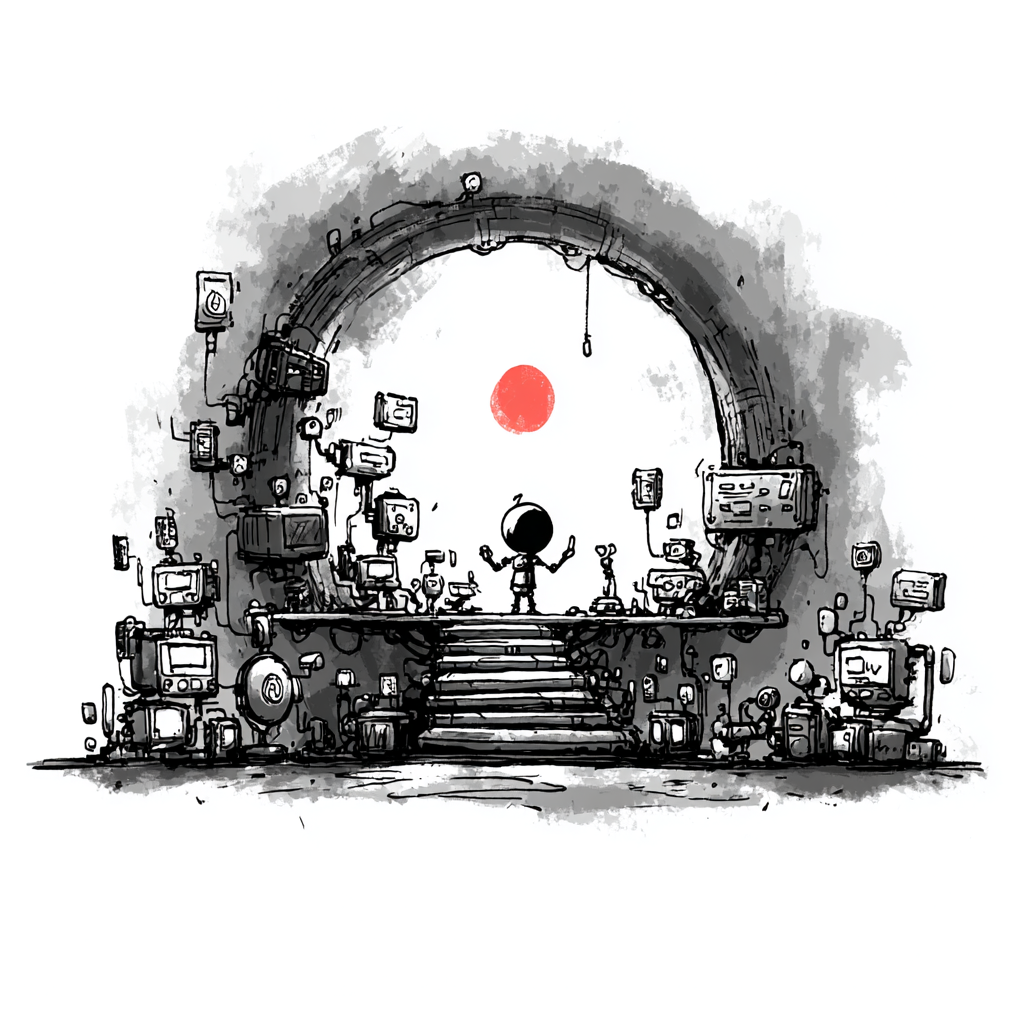
I went to Japan to give two keynotes about the Agent-First Era. Japan ended up giving the keynote back to me.
We decided to turn the trip into something bigger: Tokyo, then Hakone, up into the mountains to Takayama, on to Kyoto, and finally Osaka. Shinkansen platforms, ryokan dinners, temple gardens, late-night streets. And somewhere between the second keynote and the third city, I realised the country was quietly answering
the question I had flown in to talk about.
On stage, I had been describing a future full of AI Agents: autonomous systems that plan, negotiate, book and execute on our behalf. The usual vision of that future is loud. Dashboards, notifications, digital colleagues reporting on everything they do.
Silicon Valley measures progress by visibility, and our picture of Agents has inherited the habit.
Then I stepped off the stage and into a country that works the other way around.
The train from Tokyo to Hakone left at the exact minute printed on the ticket, as did every train after it. In Takayama, the ryokan had quietly rearranged dinner
around our late arrival before we thought to ask. In Kyoto, I stood in a temple garden that was mostly empty space, and the emptiness was clearly the point. None of it announced itself as technology, but all of it was the product of enormous, invisible coordination. The workwas there. The friction wasn't.
I'm starting to think that's what the most advanced AI Agent will feel like. Not another presence in your life, but the absence of effort.
Four Japanese concepts capture this better than anything I've read in a product roadmap: #Wa, #Omotenashi, #Kaizen and #Ma. Together they amount to something Silicon Valley doesn't currently have. Not a new model architecture, but a philosophy of how intelligent systems should behave around people.
Wa: intelligence is coordinated, not individual
#Wa is usually translated as harmony, which sounds passive. It isn't. An orchestra
isn't harmonious because everyone plays the same note; it's harmonious because each instrument knows its role and its timing relative to the whole.
That's the actual engineering problem of the Agent-First Era. The future won't be one omnipotent agent doing everything. It will be networks of specialised agents working across calendars, financial systems, databases and human teams.
One researches, another verifies, another executes, and a human decides when
judgment or accountability is required. The intelligence lives in the coordination, not in any single Agent.
Most organisations are doing the opposite. Marketing gets a copilot, finance gets a copilot, customer service gets a copilot, and each becomes locally efficient while the company stays fragmented. New silos of artificial intelligence stacked on
top of old silos of human work. I'd call that accelerated disconnection rather than
transformation.
The leadership problem, then, isn't deploying more intelligence. It's creating
harmony between different kinds of it. Less "smartest person in the room," more
conductor deciding when each capability comes in.
Omotenashi: service that acts before the request
#Omotenashi gets described as Japanese hospitality, but its real meaning is anticipating a need before anyone has to ask. Of the four ideas, this is the clearest bridge to Agents.
Traditional software waits. You open the app, navigate the menu, press the button, hope for the best. A real Agent inverts that. It notices your flight was cancelled, finds alternatives, checks your calendar, holds a seat, updates the airport transfer, and asks before spending your money. You expressed an intent; the system organised itself around you.
Here's where it gets uncomfortable, though. Anticipation requires knowledge. An Agent can't anticipate your needs without knowing your preferences, location, history and relationships, and the same data that lets it care for you lets it manipulate you. The distance between Omotenashi and surveillance is small, and the difference is constitutional rather than technical. Who does the Agent serve? Who owns its memory? Can you inspect its reasoning and revoke its access?
A hotel clerk guessing you'll need an umbrella is hospitality. A platform predicting your vulnerable moment and auctioning it off is extraction. Both are anticipation. Only one deserves trust. The real competition of this era won't be over which Agent is smartest, but over whom the anticipation serves: you, or the platform.
Kaizen: the Agent is never finished
#Kaizen rejects the single dramatic transformation in favour of thousands of small
corrections, repeated until quality becomes systemic. Agents will have to develop the same way.
Companies still treat AI like conventional software: design it, test it, launch it, done. For an Agent, launch is the beginning. It operates in ambiguous situations, interprets intent, hits exceptions, and sometimes does things its designers never
anticipated. You can't govern that with version releases and an annual review. You need a loop: watch what it did, find where its interpretation diverged from what you meant, correct it, turn the correction into a guardrail, repeat. Every failure should make the system better. Every human intervention should make the same intervention less likely next time.
This also cuts against the industry's obsession with scale. Most agentic failures won't be fixed by giving the machine a bigger brain. They'll be fixed by better context, clearer constraints and faster feedback. The winning organisation may not be the one with the most powerful model. It may be the one with the fastest learning loop.
It changes what managers do, too. Reviewing Agent behaviour becomes part of the job. Not micromanaging every action, but watching for drift between what the organisation intended and what the system learned to optimise. Your culture is no
longer just what you say at the all-hands. It's encoded in the Agents acting on your behalf.
Ma: the real product is the space left behind
#Ma may matter most. It refers to the meaningful space between things: the pause between notes, the emptiness in a room that lets you experience what's actually there. The West tends to read empty space as unused capacity. Japan often treats it
as part of the design.
That distinction should change how we measure Agents entirely. Tech companies
measure engagement: how often you open the app, how long you stay, how quickly you come back. An Agent should produce the opposite. Fewer interactions, fewer
notifications, fewer things requiring your attention at all. The old digital economy
competed to occupy every spare moment. This one should compete to give the moments back.
The most important output of an Agent is what appears once the task disappears. The meeting that no longer needs to happen. The form nobody fills in. The evening not spent reconciling spreadsheets. Saving five minutes on a task is useful; removing the task from human consciousness altogether is something else. The real dividend isn't faster work, it's reclaimed presence.
Which leaves an awkward question I can't fully answer: what do we put in the space? More meetings? More optimisation? Or judgment, relationships, and the difficult human work that doesn't reduce to a workflow? Agents can create the emptiness. They can't decide what makes it meaningful. That part is still on us.
A quieter ambition
Wa says intelligence must be coordinated. Omotenashi says service should anticipate rather than wait. Kaizen says autonomous systems have to keep improving long after launch. Ma says the point is not more activity but more room.
Silicon Valley wants Agents you can't ignore. After two keynotes and five cities, I think the more ambitious future is the opposite: machinery quiet enough that what you notice isn't the machine at work, but the space it gives back.
 Peter van Hees