The 10 Bold Predictions for AI Agents in 2026

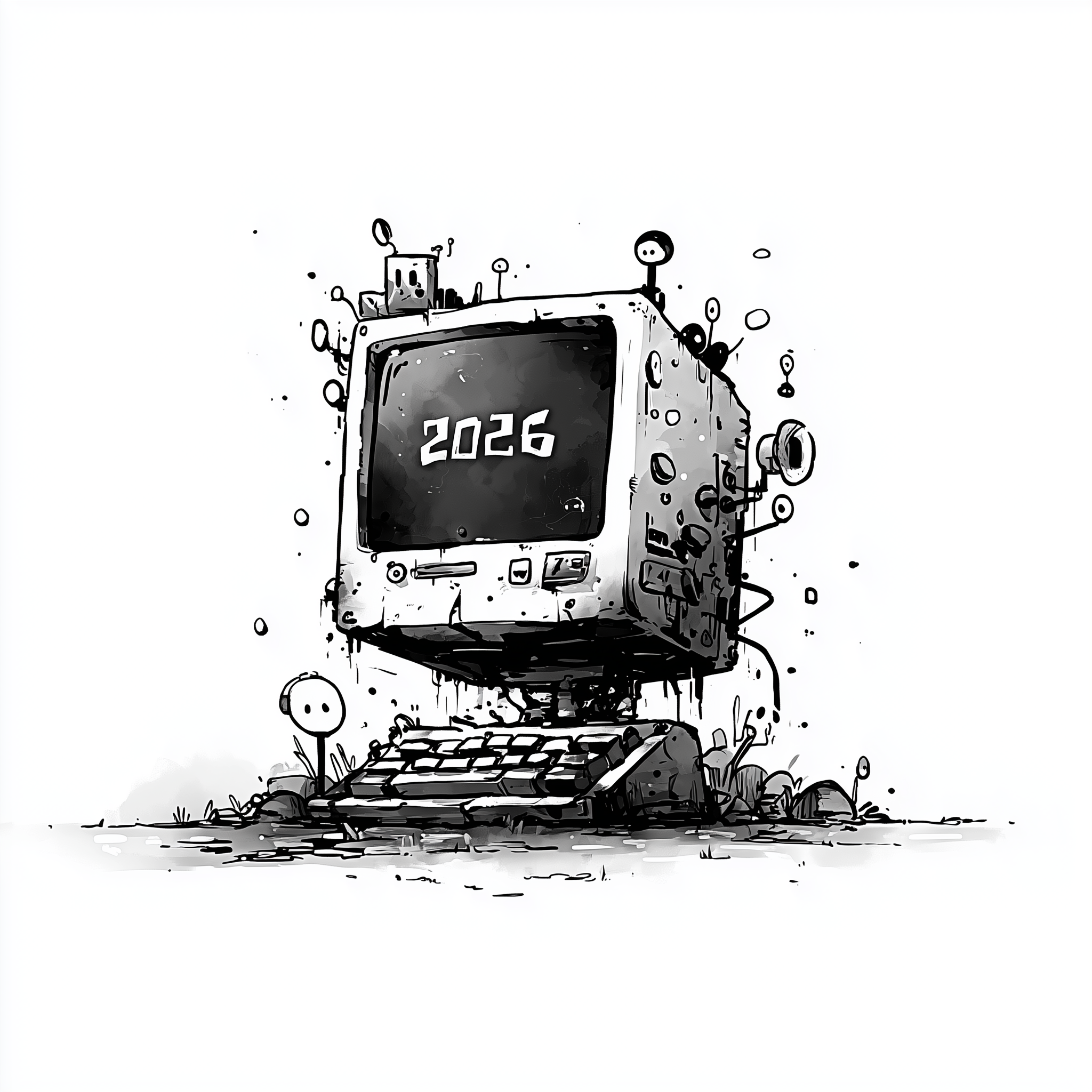
The interface you are using right now - the blinking cursor, the empty text box waiting for your command - is not the future. It is a fossil.
For three years, you have been trained to believe that "prompt engineering" is a skill. You have been acting as a manual operator for a brilliant but inert machine. This is the "Tyranny of the Mobile Tap" re-branded for the LLM era. It is a high-friction, low-leverage model that forces you to provide the initiative for every single cognitive act.
That era ends now!
My research into the trajectory of 2026 reveals a violent break from the current paradigm. We are moving from reactive software that waits for input to proactive silicon labor that hunts for outcomes. The winners of the next cycle will not be those who write better prompts. They will be the ones who architect the systems that make prompting obsolete.
Here are the 10 shifts that will start defining the Agent-First Era in 2026.
1. The Prompt Box Disappears * Context is the New Command Line
The era of typing instructions is over. The next wave of AI interfaces will not wait for you to ask. They will observe your context - your calendar, your biometrics, your logs - and intervene proactively. Interaction shifts from instruction to review. You will not tell the agent what to do; you will merely approve what it has already staged. The friction of "asking" is liquidated.
2. Software Becomes an “Employee” * The High-Agency Hierarchy
We are witnessing the death of the "tool." Tools are passive; they require your kinetic energy to function. In 2026, AI agents will start operating as high-agency employees. They will identify problems, diagnose root causes, and execute solutions before you are even aware of the friction. As my research highlights, the agent moves from the bottom of the delegation pyramid (asking "what do I do?") to the top (stating "I have solved this; please confirm").
3. The Market Explodes from Software to Labor * The $13 Trillion Opportunity
Stop looking at the $400 billion software market. It is a rounding error. The true target of the Agent-First revolution is the $13 trillion global labor market. When software transitions from aiding work to doing work, the total addressable market expands by an order of magnitude. The industry is not selling productivity tools anymore; it is selling synthetic labor.
4. Human-in-the-Loop is a Luxury * Contextual Oversight
Human oversight is no longer a default requirement; it is a design choice based on risk. In low-stakes, high-volume workflows, the human loop is eliminated entirely. Human judgment becomes a scarce, premium resource reserved strictly for high-liability domains. You do not manage the process; you manage the exception.
5. Power Users are Trainers * The Second Self
The elite operators in 2026 will not be "prompt engineers." They will be architects of their own "Second Self." Productivity will become a badge of honor measured by the number of tasks completed without human touch. Power users will deliberately feed agents deep behavioral context and memory to achieve near-full autonomy. They are not using the software; they are raising it.
6. Interfaces are Designed for Agents * From UX to AX
For two decades, we worshipped User Experience (UX)... visual hierarchy designed for human eyes. That era is dead. The primary reader of your system will now be a machine. As my research indicates, visual polish declines in importance; machine legibility becomes the only metric that matters. If your data structure is opaque to an agent, your business does not exist.
7. Optimization Shifts to Comprehension * The End of the Hook
Marketing has spent a century optimizing for the fragile human attention span: hooks, headlines, and narrative flow. Agents do not need hooks. They do not skim. They read everything. Content optimization shifts from persuasion to precision. Structured meaning, semantic clarity, and factual density are the new SEO. You are no longer writing to persuade a human; you are writing to inform a machine.
8. Hyper-Volume Content * The New Spam Risk
The cost of content generation has collapsed to zero. This creates a new systemic risk: organizations flooding the ecosystem with low-quality, agent-targeted sludge to game the relevance algorithms. This mirrors the early days of SEO spam but at an industrial scale. The defense against this is not more content, but verified content... in my book I refer to this as the "Scarcity of the Real."
9. Voice Becomes Infrastructure * The Default Frontline
Voice agents have crossed the credibility threshold. They are moving from novelty to infrastructure in healthcare, banking, and government services. They outperform humans on compliance, availability, and multilingual accuracy. The "call center" is no longer a room of people; it is a server rack of agents that never sleep, never churn, and never deviate from the script.
10. Service Industries are Repriced * The Underbid is Coming
The Business Process Outsourcing model is being hollowed out. Service providers will not vanish, but they will be ruthlessly repriced around AI-augmented economics. Any service that sells routine execution without a human value-add will see its margins compressed to zero.
Conclusion * The Structural Shift
These ten shifts point to a single, unavoidable truth: We are moving from human-operated software to human-supervised systems.
The winners of 2026 will not be the ones who build better tools. They will be the ones who design better trust boundaries, clearer delegation models, and robust approval layers. This is not a UX evolution. It is a redefinition of work itself.
The prompt box is dead. Long live the intent.