Your LLM Is an Operating System * AIOS Architecture
Your AI strategy is a model shopping list. The AIOS Architecture maps four layers that determine whether your stack compounds value or becomes commodity. Stop picking kernels. Start building the operating system.

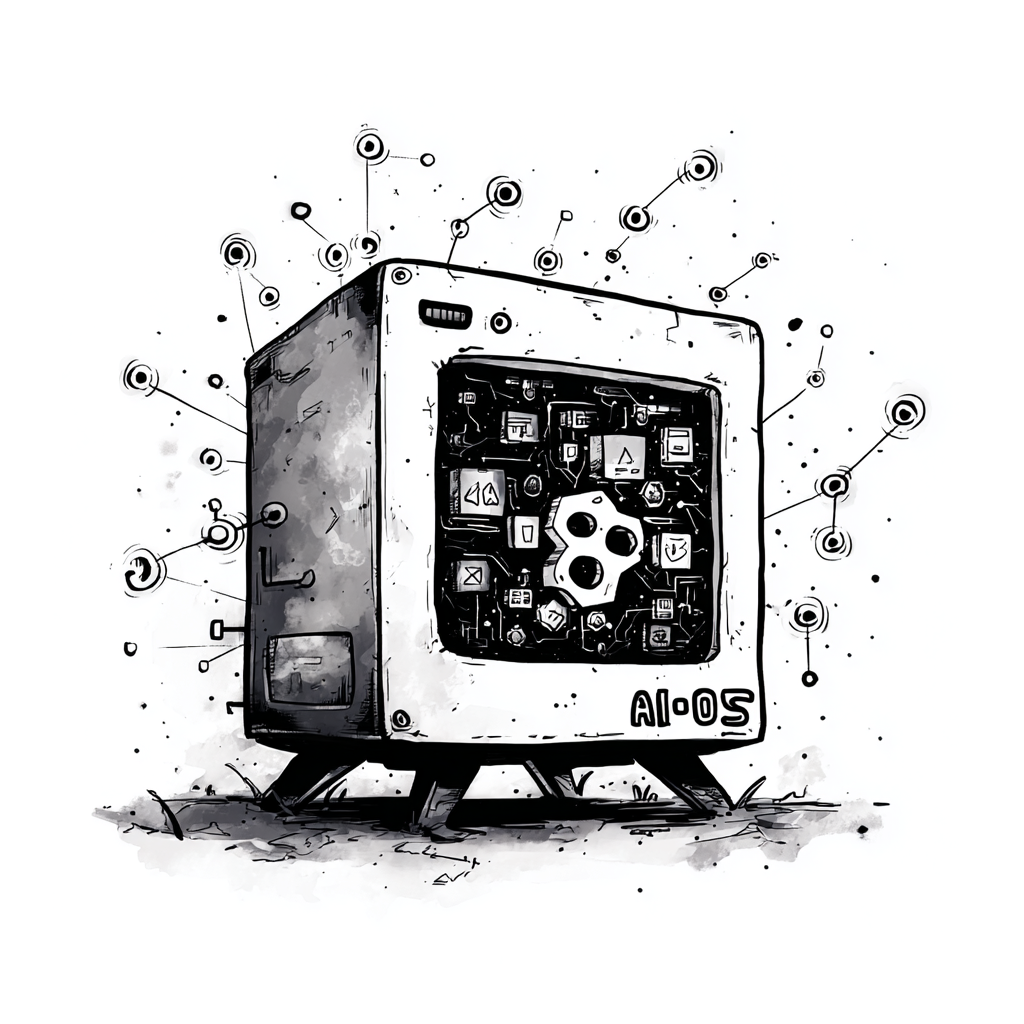
Your AI strategy is a shopping list of models, and it is about to become as defensible as a list of preferred vacuum tube brands in 1957..
I call this the AI Operating System (AIOS) Architecture, a four-layer framework that maps your AI Agent stack to classic computing principles: kernel, memory, file system, system calls. Traditional computers execute instructions deterministically: the same input produces the same output, every time. The AIOS processes inputs probabilistically, producing different outputs from identical prompts. That distinction rewires how you architect, test, and trust the system. This article shows you exactly which layer to stop investing in and which three layers will determine whether your AI stack is a strategic asset or an expensive commodity.
The Model Obsession
You spent last weekend comparing GPT-5.2 benchmarks against Claude Opus 4.5 and Gemini 3 Pro. You built a spreadsheet. You ranked them by task. You felt productive. You wasted your time.
The foundation model debate is the defining distraction of 2026. While you agonize over which kernel to license, the architecture that will determine your competitive position for the next decade sits unbuilt. You are repeating the mistake of every enterprise IT department in 1995 that obsessed over which brand of microprocessor to install while a company in Redmond captured the entire value layer above it.
I introduced the AIOS Architecture in AI Agents: They Act, You Orchestrate to make this structural truth visible. The foundation model is the kernel. The context window is memory. The vector database is the file system. Function calling is the system calls layer. Every major platform vendor has since validated it with their own shipping architectures. Microsoft, Google, Apple, and OpenAI arrived at the same blueprint independently. When four engineering organizations solving the same problem converge on the same structure, you have found a law, not a trend.
The Commodity Kernel
GPT-4-level performance cost $30 per million tokens in early 2023 [1]. It costs under $1 today. That is a 97% price collapse in three years. Open-source models from Meta, Mistral, and Alibaba now match proprietary benchmarks at 90% lower cost [2]. The gap between open-source and proprietary performance vanished in 2025.
The kernel is becoming a commodity, and any strategy built on owning the best one is a strategy built on sand.
GPT-5.2 leads on mathematics. Claude Opus 4.5 leads on coding. Gemini 3 Flash beats its own Pro sibling on 18 of 20 benchmarks. No single model dominates. Specialization, not supremacy, is the pattern. And specialization without orchestration is a collection of disconnected tools, not a system. Every dollar you invest in model-specific fine-tuning earns a declining return. Every dollar you invest in model-agnostic orchestration compounds. Your kernel will be obsolete in 18 months. Your orchestration layer will compound for a decade.
The Memory Trap
A bigger context window does not solve the AI memory problem. It creates the illusion that the problem is solved while masking the fundamental architectural flaw of treating volatile memory as persistent storage.
Context windows exploded from 8,000 tokens in 2023 to 2 million tokens in Gemini, 1 million in Claude, and 400,000 in GPT-5 by early 2026 [3]. That expansion feels like progress. It is a trap. Research confirms that a model advertising 200,000 tokens of context becomes unreliable at 130,000, with sudden performance drops rather than gradual degradation [4]. You do not get 65% of a context window. You get 65% that works and 35% that fails without warning.
I draw the distinction in the book: the context window is working memory, not a hard drive. It handles the current session. It does not give the agent a history or a persistent understanding of your intent. The vector database market is projected to grow from $2.65 billion in 2025 to $8.95 billion by 2030, a 27.5% compound annual growth rate [5]. Retrieval-augmented generation (RAG) now runs in 51% of enterprise AI implementations [6]. The enterprises building durable AI systems are not waiting for bigger context windows. They are architecting persistent, auditable file systems. Working memory is necessary. The file system is strategic.
The Most Defensible Layer
Function calling is the system calls layer that allows an AI Agent to execute actions in external systems rather than merely generate text. Your proprietary tool integrations are the most defensible asset in your AI stack.
A foundation model without function calling is a consultant who writes brilliant memos but cannot touch your systems. It reasons. It does not act. Every function call endpoint you build is a compound asset. Every integration you wire into your proprietary systems raises the cost for a competitor to replicate your position by licensing a different model.
Model Context Protocol (MCP) has reached 97 million monthly SDK downloads one year after launch [7]. Anthropic, OpenAI, Google, and Microsoft all back it. CData's enterprise adoption report calls it the USB-C of AI [8]. Gartner predicts 40% of enterprise applications will embed task-specific AI Agents by the end of 2026, up from less than 5% in 2025 [9]. The deployment driver is not better conversation. It is agents that execute. Your competitors can license the same kernel you use. They cannot replicate the 200 function call endpoints you built into your proprietary systems. That integration layer is your iOS.
The Real Battleground
You have been sold a story that says your AI strategy is a model selection exercise. Pick the best foundation model. Fine-tune it. Build features on top. That story is a fossil.
Apple did not win by building a better CPU. Apple won by building iOS. The CPU was a commodity part sourced from Samsung, then TSMC. The operating system, the memory management, the app integration: that architecture is worth three trillion dollars. The CPU is a line item.
The AIOS Architecture reveals the same structural truth about your AI stack. The kernel is commoditizing at 97% in three years. The context window is unreliable past 65% of its advertised capacity. The real value sits in two layers: the file system and the system calls. These layers compound competitive advantage and create switching costs that protect your position.
The foundation model you license will be obsolete in 18 months. The orchestration architecture you build around it will compound for a decade. Stop picking kernels. Start building your operating system.
This article scratches the surface of one framework from AI Agents: They Act, You Orchestrate by Peter van Hees. The book maps 18 chapters across the full architecture of the Agent-First Era, from the Delegation Ladder that governs how you instruct agents to the platform wars reshaping Big Tech to the human skills that survive automation. If the four-layer AIOS Architecture reframed how you think about your AI stack, the book gives you the complete operating system for the decade ahead. Get your copy:
🇺🇸 Amazon.com
🇬🇧 Amazon.co.uk
🇫🇷 Amazon.fr
🇩🇪 Amazon.de
🇳🇱 Amazon.nl
🇧🇪 Amazon.com.be
References
[1] OpenAI, "GPT-4 API Pricing," 2023. https://openai.com/api/pricing/
[2] Meta AI, "Llama 3 Benchmarks," 2025. https://ai.meta.com/blog/meta-llama-3/ ; Mistral AI, "Mistral Large Performance Report," 2025. https://mistral.ai/news/mistral-medium-3
[3] Google, "Gemini 2 Million Token Context," 2025. https://cloud.google.com/blog/products/ai-machine-learning/vertex-ai-io-announcements ; Anthropic, "Claude 1M Context," 2025. https://www.anthropic.com/news/claude-3-family ; OpenAI, "GPT-5 Specifications," 2026. https://openai.com/index/introducing-gpt-5/
[4] Liu et al., "Lost in the Middle: How Language Models Use Long Contexts," 2023. https://arxiv.org/abs/2307.03172
[5] MarketsandMarkets, "Vector Database Market Forecast 2025-2030," 2025. https://www.marketsandmarkets.com/Market-Reports/vector-database-market-112683895.html
[6] Databricks, "State of Data + AI Report," 2025. https://www.databricks.com/resources/ebook/state-of-data-ai
[7] Anthropic, "Model Context Protocol Adoption Metrics," 2026. https://www.anthropic.com/news/donating-the-model-context-protocol-and-establishing-of-the-agentic-ai-foundation
[8] CData, "Enterprise AI Integration Report," 2026. https://www.cdata.com/lp/ai-data-connectivity-report-2026/
[9] Gartner, "AI Agent Deployment Forecast," 2026. https://www.gartner.com/en/newsroom/press-releases/2025-08-26-gartner-predicts-40-percent-of-enterprise-apps-will-feature-task-specific-ai-agents-by-2026-up-from-less-than-5-percent-in-2025