Stop Optimizing Your UI * Command Inversion
You spent six figures redesigning your product interface. That investment is a depreciating asset. Command Inversion, the principle that context replaces clicks, is dissolving the GUI. Peter van Hees explains the framework and the governance architecture you need before it dissolves yours.

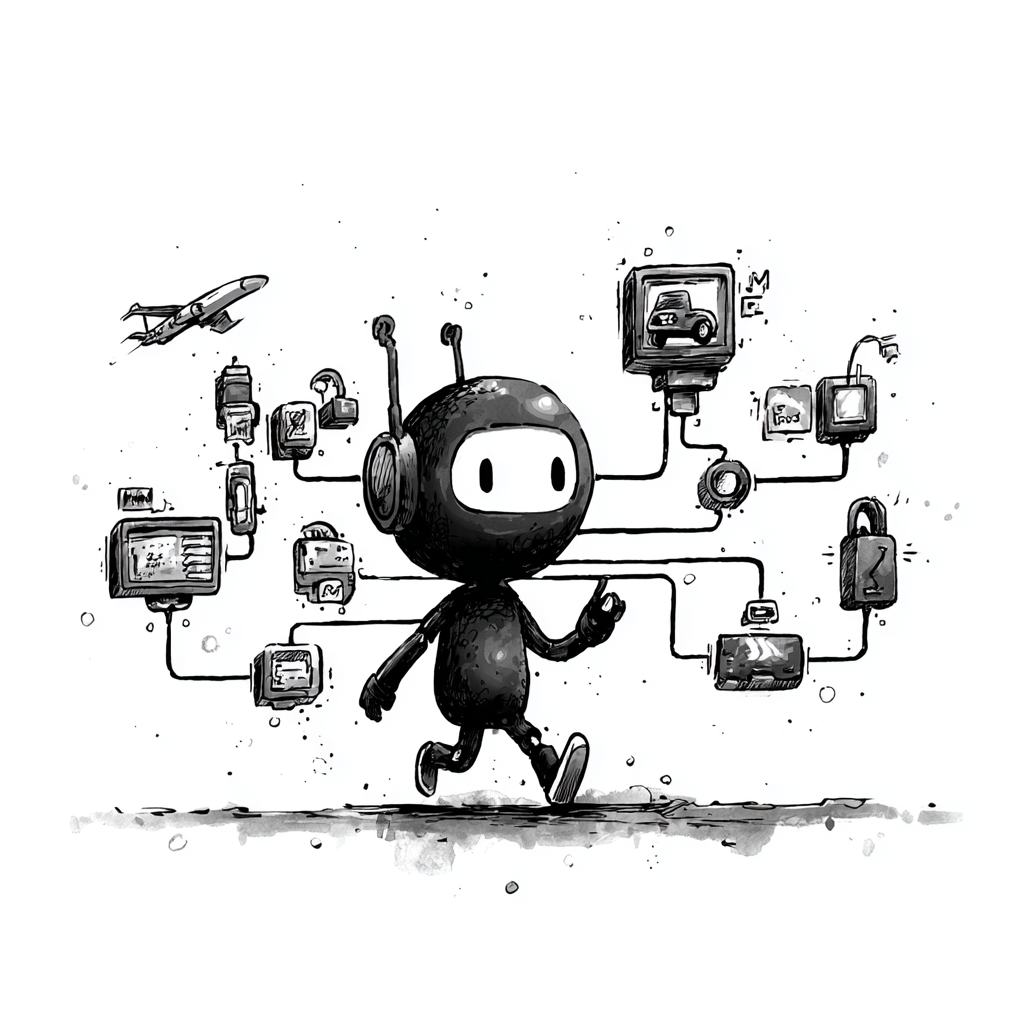
You spent six figures redesigning your product's interface. That money is gone. The next generation of your competitors will not ship better screens. They will ship no screens at all.
I call this structural shift Command Inversion: the principle that replaces explicit user commands with ambient contextual data. You will learn why the graphical user interface (GUI) is a dead architecture, how proactive AI agents already replace explicit commands with ambient data, and what governance framework you need before you surrender the terms of that bargain to someone else.
Why Are You Still Paying the Interface Tax?
The click-based interface is a tax. The average knowledge worker surrenders 10% of their workday to application navigation alone [1]. That same worker loses 40% of deep work time to context switching [1]. McKinsey puts the information-search penalty at 20% of the working week: one full day out of every five spent hunting for data that should have found them [2].
Run the arithmetic. A knowledge worker earning $150.000 per year works roughly 2.000 hours. Ten percent lost to navigation is 200 hours. At $75 per hour, that is $15.000 per employee per year in pure interface friction. For a 500-person company, you are looking at $7,5 million annually, burned on taps, toggles, and tab switches. Asana measured the collateral damage: 103 hours per year in unnecessary meetings and 209 hours on duplicative work, per person [3]. Call them what they are: structural liabilities, baked into the architecture of every application your team touches.
Every UX redesign that accepts the click-based paradigm as a given is optimizing within a losing constraint. You are polishing the bars of a cage. The ROI ceiling on GUI improvement is capped by the architecture itself. I wrote about this in my book AI Agents: They Act, You Orchestrate, where I named this architectural chokepoint the Tyranny of the Tap, the force that taxes your cognitive bandwidth through an interface designed to rent out your attention, not deliver outcomes.
The metric that matters is the TtO Dividend, the measure of time an agent gives you back by eliminating friction. Every click between intent and outcome is a deduction from that dividend. Your UX budget is subsidizing that deduction.
How Do Proactive AI Agents Replace Commands?
Command Inversion replaces explicit user commands, taps, clicks, typed prompts, with ambient contextual data. The agent fuses location (GPS), calendar, biometrics, email, and purchase history into a high-fidelity model of your intent, then acts before you reach for the screen. Your role shifts from commander to Orchestrator.
Consider the proof of concept. A business traveler sits in a car, 45 minutes from the airport for a 4PM flight. The airline API pings a seven-hour delay. Her agent synthesizes calendar data, GPS coordinates, available flights on competing airlines, her digital wallet balance, and her standing directive: minimize transit time. Without a single tap, the agent queries alternative flights, locks a seat, cancels the old car pickup, books a new one timed to the revised arrival, and delivers one sentence to her earbud: "Your flight is delayed seven hours. I found an alternative that gets you there on time. I held the seat and updated your pickup. Say confirm to execute."
She drove. Context was the command.
This is not a theoretical capability. IBM defines the divide plainly: "AI assistants are reactive, performing tasks at your request. AI agents are proactive, working autonomously to achieve a specific goal" [4]. The ambient computing market stood at $59 billion in 2025 and is projected to reach $438 billion by 2033, a 24.59% compound annual growth rate [5]. Companies using Slack already deploy proactive agents in IT operations, where they detect infrastructure incidents before users report outages, trigger diagnostics, and route remediation workflows autonomously [6]. In sales, these agents identify stalled deals and draft follow-up messages before the account manager notices the silence [6].
I did not invent context-aware computing. But Command Inversion names the architectural principle that context-aware computing has been building toward for decades: the systematic elimination of the command itself. Your product roadmap should not include a better GUI. It should include a context ingestion layer that makes the GUI unnecessary.
What Privacy Do You Surrender to Proactive AI Agents?
Command Inversion demands intimate access. To serve you, the agent must read your email, sense your stress, and track your location. This creates what I call the Benevolent Surveillance Dilemma, the necessary bargain where you trade data access for friction elimination in the Agent-First Era.
Your unease is justified. For two decades, surveillance meant your data was harvested covertly and sold to advertisers. You were the product. The new bargain is structurally different. You invest your data with your own agent in exchange for a tangible return: the destruction of friction and the recovery of your time. The agent works for you, on your terms.
The American Civil Liberties Union (ACLU) warned in March 2025 that "limits and guardrails are vital to protect our privacy and liberty against omnipresent AI surveillance" [7]. Frontiers in AI research, cited 234 times, identified privacy as the dominant public concern about AI technologies [8]. These warnings are correct. They are also incomplete. Privacy absolutism keeps you locked inside the Tyranny of the Tap. The only question that matters: who writes the terms.
I architect those terms through the Four Mandates of Agency, a governance framework that defines the non-negotiable boundaries for agent data access.
- Proportionality: grant the minimum access required for the task. A scheduling agent needs your calendar, not your photo library.
- Purpose Limitation: data granted for one task cannot bleed into another without explicit consent.
- Transparency: the agent must declare what data it consumed and why. A black box is a liability, not a partner.
- Revocation: you hold an Intelligent Circuit Breaker for each data stream, severing access without shutting down the entire system.
I introduced this framework in Chapter 4 of my book AI Agents: They Act, You Orchestrate. These mandates are load-bearing walls. Without them, user adoption collapses, or users surrender by default and become the product again.
Should You Automate Everything?
No. The real danger of Command Inversion is Learned Helplessness.
Systems that eliminate all friction create cognitive atrophy. The human mind strengthens through resistance. When you architect a world that never requires effort, you engineer a population that cannot function without its tools. The Verge documented the first wave of this backlash in December 2025: generative AI assistants broke basic smart home functionality by over-triggering and misinterpreting context [9]. Slack's own research on proactive agents warns that "agents that act too frequently can overwhelm users" and that "suggestions that are incorrect or out of touch with the current situation" erode trust [6].
I built a defense against this. The Deliberate Friction Framework is the governance model that separates depleting tasks from developing skills. Depleting tasks, scheduling, data entry, navigation, are candidates for full automation. Developing skills, strategic analysis, negotiation, creative synthesis, must keep their resistance. You calibrate a friction dial for each: turn it down where automation liberates, turn it up where effort builds capacity. Then you schedule cognitive workouts, periodic manual engagement with the skills you have deemed essential.
The Orchestrator who automates everything becomes a passenger. The Orchestrator who calibrates friction remains the architect.
The Reversal You Did Not See Coming
You came to this article thinking your problem was too much friction. You assumed better interfaces, fewer clicks, smoother flows would close the gap. The evidence says otherwise. The gap is the interface itself. Command Inversion dissolves it.
But here is the reversal you did not anticipate: a world without friction is a world that atrophies. The hardest architectural decision in the Agent-First Era is not what to automate. It is what to protect from automation. The companies that win will not be the ones that eliminate every click. They will be the ones that know exactly which clicks to keep.
You face two architectures. One optimizes the screen. The other dissolves it. Command Inversion is already underway; Amazon, Google, and Apple are spending billions to own the context layer that replaces your interface [10]. Your only decision is whether you write the terms of that dissolution or inherit someone else's.
Stop designing for clicks. Start architecting for context. And build the deliberate friction that keeps your users, and yourself, from forgetting how to think.
Command Inversion is one framework from one chapter of AI Agents: They Act, You Orchestrate by Peter van Hees. The book maps 18 chapters across the full architecture of the Agent-First Era: the AIOS Architecture that powers proactive agents, the Delegation Ladder that calibrates autonomy, the Human Premium Stack that defines which human skills survive, and the Deliberate Friction Framework that protects you from automation's success. If the tension between dissolving interfaces and preserving agency resonated, the book gives you the complete blueprint. Get your copy:
🇺🇸 Amazon.com
🇬🇧 Amazon.co.uk
🇫🇷 Amazon.fr
🇩🇪 Amazon.de
🇳🇱 Amazon.nl
🇧🇪 Amazon.com.be
References
[1] Workelate, "Minimal UI and the End of App Fatigue." https://www.workelate.com/blog/minimal-ui-and-end-app-fatigue
[2] McKinsey, cited in Productivity Gladiator, "Digital Clutter Is Slowing You Down." https://www.productivitygladiator.com/blog/digital-clutter-is-slowing-you-down-heres-some-ideas-on-digital-organization-you-should-steal
[3] Asana, "Why Work About Work Is Bad," April 2025. https://asana.com/resources/why-work-about-work-is-bad
[4] IBM, "AI Agents vs. AI Assistants." https://www.ibm.com/think/topics/ai-agents-vs-ai-assistants
[5] Globe Newswire, "Ambient Computing Market Poised for Rapid Growth," January 2026. https://finance.yahoo.com/news/ambient-computing-market-poised-rapid-144600914.html
[6] Slack, "Proactive AI Agents: Definition, Core Components, and Business Value." https://slack.com/blog/productivity/proactive-ai-agents-definition-core-components-and-business-value
[7] ACLU, "Machine Surveillance is Being Super-Charged by Large AI Models," March 2025. https://www.aclu.org/news/privacy-technology/machine-surveillance-is-being-super-charged-by-large-ai-models
[8] Frontiers in Artificial Intelligence, "AI Technologies, Privacy, and Security," 2022. https://www.frontiersin.org/journals/artificial-intelligence/articles/10.3389/frai.2022.826737/full
[9] The Verge, "How AI Broke the Smart Home in 2025," December 2025. https://www.theverge.com/tech/845958/ai-smart-home-broken
[10] eMarketer, "Amazon and Google Square Off with AI-Driven Smart Home Strategies," October 2025. https://www.emarketer.com/content/amazon-google-square-off-with-ai-driven-smart-home-strategies