Engineers Stopped Writing Code in December * Project-Scale Autonomy Is Here.
Three frontier models shipped in six days in November 2025, and the engineering profession crossed a line it will never cross back. This is the second acceleration: from task-scale to project-scale autonomy. Your sprint board is the fossil.

In the last six days of November 2025, three frontier models shipped within a single week, and the engineering profession crossed a line it will never cross back. Gemini 3 Pro on November 18. Claude Opus 4.5 on November 24. GPT-5.1 days later. All three optimized for the same capability: long-running AI agents that sustain autonomous work across hours and days, not minutes [1]. This was a convergence, not a coincidence. The frontier labs arrived at the same architectural conclusion at the same moment.
This article maps the convergence that made project-scale autonomy real, explains why the most experienced engineers alive stopped writing code, and gives you the framework for what comes after Agile.
What Did the Frontier Models Actually Converge On?
The coverage treated December 2025 as a capabilities story. Smarter models. Better benchmarks. Faster autocomplete. That framing misses the structural event entirely. The convergence was architectural, not incremental.
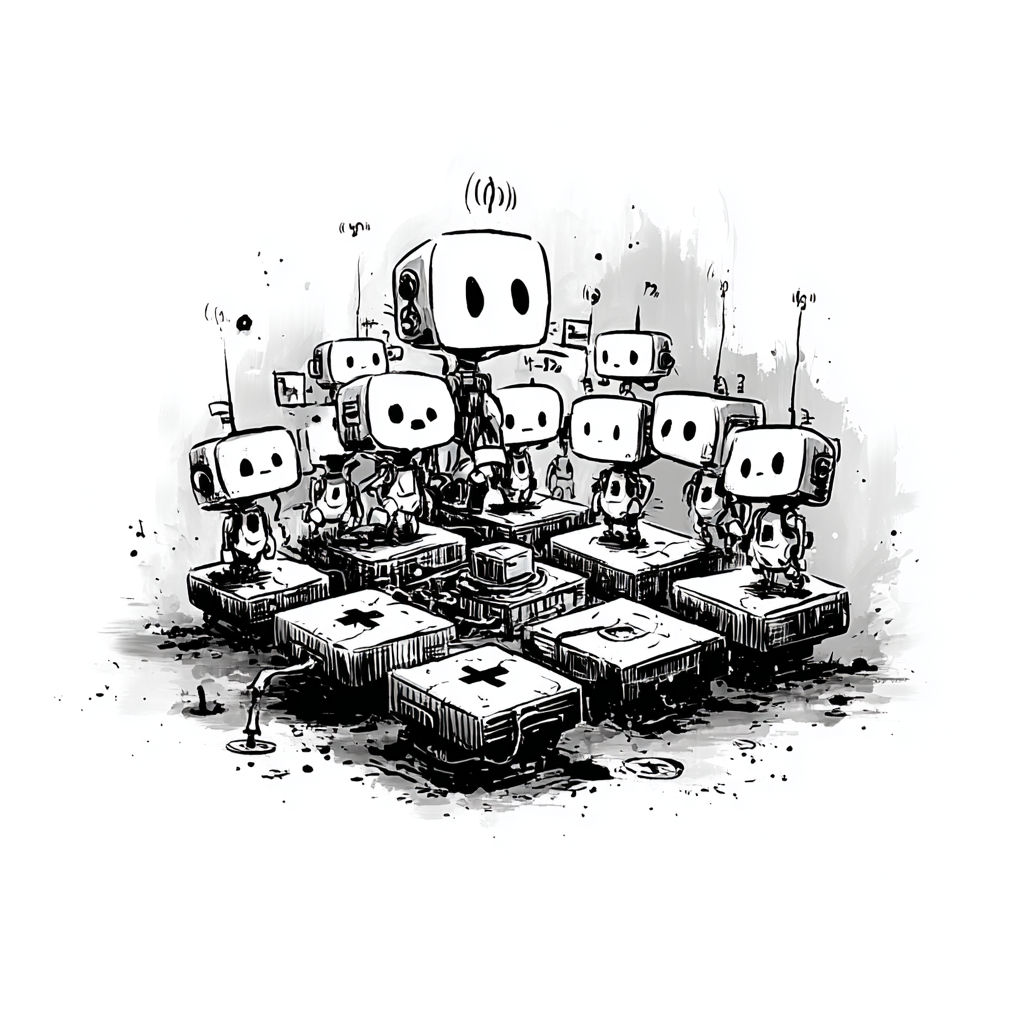
Every major model provider converged on a single architectural bet: long-running autonomous operation. Long-running AI agents are systems that sustain execution across hours or days without human intervention. Not chat. Not code completion. Multi-hour, multi-context-window agent execution. Anthropic published its engineering blueprint for long-running agent harnesses on November 26, 2025, detailing context compaction, initializer-agent patterns, and progress persistence across sessions [2]. Cursor deployed hundreds of concurrent agents against a single codebase in January 2026, producing three million lines of code for its FastRender browser in a single week [3].
The first acceleration of AI agency, from 2022 through 2024, moved us from tools to assistants to agents. The second acceleration moves agents from minute-scale tasks to day-scale projects. Project-scale autonomy is the capability to delegate an entire deliverable, not just a subtask, to autonomous execution. Task-scale autonomy required a good model. Project-scale autonomy requires a good model and orchestration infrastructure mature enough to sustain it. December 2025 delivered both simultaneously.
If you are still evaluating AI through the lens of chat-based coding assistance, you are evaluating the wrong capability.
Why Did Top Engineers Stop Writing Code?
The structural shift has a name and a face. Andrej Karpathy, co-founder of OpenAI and former Director of AI at Tesla, stated in January 2026 that his workflow “rapidly went from about 80% manual+autocomplete coding to 80% agent-assisted” in a matter of weeks [4]. Project-scale autonomy reached viability, and the most experienced practitioners recognized it first. Karpathy coined the term vibe coding less than a year earlier. He has decades of professional coding experience and sits at the intersection of frontier capability and frontier adoption. He inverted his entire method of working in weeks.
Ethan Mollick, Associate Professor at Wharton, author of Co-Intelligence: Living and Working with AI, and one of the closest academic observers of AI adoption in business, put it more bluntly: “Projects from six weeks ago may already be obsolete” [5].
When the most credentialed practitioners in a field abandon their own methods at this velocity, you are not observing incremental improvement. You are observing a phase transition. Karpathy’s inversion is a leading indicator. Within 12 to 18 months, every senior engineer will face the same reckoning.
How Does AI Build Better AI?
The convergence produced a recursive loop at the frontier. At Anthropic, engineers report: “I don’t write code anymore, I let the model write the code” [6]. Dario Amodei shared this at Davos in January 2026, alongside his assessment that 90% of code at Anthropic is now AI-written. At OpenAI, the pattern is identical. The company announced in January 2026 that it is “dramatically slowing” its pace of hiring, because existing engineers have expanded their productive span by an order of magnitude [7]. Better models produce better engineering tools. Better engineering tools produce better models, faster. AI builds AI.
The numbers expose the divide. At Anthropic and OpenAI, 90% of code is AI-written [6]. At most software companies, the figure sits between 25% and 40%. That is a three-year capability gap compressed into 18 months. Organizations that fail to close this gap do not fall behind gradually. They subsidize their competitors’ acceleration.
What Orchestration Infrastructure Makes Long-Running Agents Work?
Model capability alone did not produce the second acceleration. Orchestration infrastructure matured at the precise moment the models crossed the sustained-autonomy threshold. The answer is context engineering, progress persistence, and specification-driven delegation.
Geoffrey Huntley’s Ralph Wiggum pattern, a bash loop that continuously restarts AI coding agents with fresh context windows while persisting progress through git commits and structured files, demonstrated that long-running agent work is an engineering problem with engineering solutions [8]. Anthropic’s initializer-agent architecture separates task planning from task execution, allowing agents to work across dozens of context windows without losing coherence [2]. Cursor’s swarm deployment proved the pattern scales: hundreds of agents, one codebase, three million lines, one week [3].
These patterns are the load-bearing walls of project-scale autonomy. I mapped this architectural principle in my book AI Agents: They Act, You Orchestrate as the Delegation Ladder, a four-stage framework for moving work from human description to autonomous execution: Describe, Specify, Validate, Autonomize. The December convergence is what happens when the Autonomize rung becomes structurally viable. The models are the fuel. The orchestration patterns are the engine. December 2025 was ignition.
What Replaces Agile Methodology?
The convergence dissolves Agile methodology. When implementation is commodified, sprint velocity becomes a metric from a dead era. Thoughtworks calls the emerging paradigm specification-driven development: the human writes acceptance criteria, the agent writes code, and evaluation replaces manual review [9]. A single Orchestrator directing a fleet of agents can execute in one week what a team of 12 engineers delivered in six, as Cursor’s FastRender project demonstrated [3].
I call this the operational expression of the Delegation Ladder. You stop describing vague goals. You start specifying machine-testable intent. You validate against acceptance criteria. You autonomize the execution.
The Functional Dissolution Principle, which I explore in AI Agents: They Act, You Orchestrate, predicts this precisely. The Functional Dissolution Principle states that any organizational function whose operations can be defined by rules and whose outcomes can be verified is a candidate for full dissolution into autonomous execution. The engineering department, as currently structured, meets both criteria. The role of the engineering leader evolves from managing coders to orchestrating agents.
The early economic signals confirm the structural shift. Employment for software developers aged 22 to 25 has declined nearly 20% since late 2022 [10]. Entry-level job postings requiring less than one year of experience dropped from 3.2% of all listings in 2022 to 1.2% in 2025 [10]. I built the Human Premium Stack as a framework for identifying irreducibly human value: High-Context Negotiation, Moral Arbitration, and Zero-to-One Innovation. These three capabilities define where the remaining human advantage concentrates. The path to the engineering profession now runs through orchestration, not implementation.
The Intelligence Briefing You Owe Yourself
Most observers missed the real story. The press covered December 2025 as a product launch. Three companies released better models. The real event was structural. Three frontier model families crossed the sustained-autonomy threshold at the exact moment orchestration infrastructure matured enough to harness them. The models were ready. The harnesses were ready. The convergence was ignition for a self-reinforcing cycle that now accelerates without external input.
I wrote this article because the framing matters. I'm telling you: the label you attach to December 2025 determines your response. If you call this better AI models, you upgrade your Copilot subscription and wait for the next release. If you call it the second acceleration, you recognize that your engineering organization faces a phase transition from writing code to specifying intent, and you act accordingly.
The second acceleration has begun. Your models are ready. Your orchestration patterns are documented. The only variable left is whether you architect the Delegation Ladder into your engineering organization before your competitor does. December 2025 was not a product launch. It was ignition. You are choosing between two versions of your company: one that writes code, and one that writes intent.
This article maps one convergence event through one framework. The full architecture spans 18 chapters in AI Agents: They Act, You Orchestrate by Peter van Hees, from the Autonomy Spectrum that classifies agent capability to the Human Premium Stack that identifies the work that remains irreducibly yours. If the shift from coding to specifying intent resonated, the book gives you the complete Delegation Ladder, the Functional Dissolution Principle, and the Economy of Intent. Get your copy:
🇺🇸 Amazon.com
🇬🇧 Amazon.co.uk
🇫🇷 Amazon.fr
🇩🇪 Amazon.de
🇳🇱 Amazon.nl
🇧🇪 Amazon.com.be
References
[1] Maxim AI, “Gemini 3 Pro vs Claude Opus 4.5 vs GPT-5.1: The Ultimate Frontier Model Comparison,” 2025. https://www.getmaxim.ai/articles/gemini-3-pro-vs-claude-opus-4-5-vs-gpt-5-the-ultimate-frontier-model-comparison/
[2] Anthropic Engineering, “Effective harnesses for long-running agents,” November 26, 2025. https://www.anthropic.com/engineering/effective-harnesses-for-long-running-agents
[3] Cursor, “Scaling long-running autonomous coding,” January 14, 2026. https://cursor.com/blog/scaling-agents
[4] Natively, “What is Vibe Coding? Complete Guide 2026,” January 2026. https://natively.dev/articles/what-is-vibe-coding
[5] Ethan Mollick, LinkedIn post, January 2026. https://www.linkedin.com/posts/daniellozovsky_sam-altmans-confession-why-the-ceo-of-openai-activity-7424855374777987073-X-qS
[6] Fortune, “At Davos, CEOs said AI isn’t coming for jobs as fast as Anthropic CEO Dario Amodei thinks,” January 27, 2026. https://fortune.com/2026/01/27/at-davos-ceos-said-ai-isnt-coming-for-jobs-as-fast-as-anthropic-ceo-dario-amodei-thinks/
[7] Business Insider, “Sam Altman said OpenAI is planning to ‘dramatically slow down’ its pace of hiring,” January 26, 2026. https://www.businessinsider.com/sam-altman-said-openai-plan-dramatically-slow-down-hiring-ai-2026-1
[8] Geoffrey Huntley, “Ralph Wiggum as a ‘software engineer,’” ghuntley.com. https://ghuntley.com/ralph/
[9] Thoughtworks, “Spec-driven development,” Medium, 2025. https://thoughtworks.medium.com/spec-driven-development-d85995a81387
[10] ADP Research / Stanford Digital Economy Study, “Yes, AI is affecting employment. Here’s the data,” August 2025. https://www.adpresearch.com/yes-ai-is-affecting-employment-heres-the-data/